

3 Checks to Confirm Big 9 HMO Access for Philippine SMEs
Yes, premium HMO plans sold to Philippine SMEs commonly include cashless access to some or all of the Big 9 hospitals, but “commonly” is not “guaranteed.” Coverage depends on which hospitals your specific plan actively lists, not just what the insurer’s marketing brochure claims. Before you enroll or renew, check the insurer’s live hospital directory and confirm the Big 9 hospitals your workforce actually uses are still accredited, cashless, and unrestricted by room-class limits.
TL;DR:
- The Big 9 hospital list varies by insurer and should be verified in real-time through direct calls and updated directories, not just marketing materials.
- Cashless hospital admissions require pre-authorization and depend on plan-specific accreditation, room classes, and hospital participation, which can change annually.
- For smooth claim processing, employers must confirm hospital coverage in writing before procedures, especially for high-cost or elective treatments at premier hospitals.
- Prioritize plans that reflect your workforce’s hospital habits, offer digital claims, 24/7 emergency support, and clear exclusions rather than just long hospital lists.
- Verifying current Big 9 coverage involves checking hospital directories, calling insurers and hospitals, and documenting all confirmations to prevent claim issues later.
Table of Contents
- What Are the Big 9 Hospitals in HMO Coverage?
- How Do HMO Networks Handle Big 9 Hospital Admissions?
- How Do You Verify a Plan Still Covers a Specific Big 9 Hospital?
- What Should SMEs Prioritize When Choosing a Big 9 HMO Plan?
- How Does HMO Plans Map to Big 9 Access and SME Needs?
- How Do Big 9 Hospital Benefits Vary Across HMO Plans?
- What Exclusions Commonly Limit Big 9 Hospital Coverage?
- How Are Claims Processed at Big 9 Hospitals vs. Other Hospitals?
- What Are Patient Rights When Using Big 9 Hospitals Under HMO Plans?
- What HR Teams Get Wrong About Big 9 Access
- How HMO Plans Helps SMEs Get Verified Big 9 Access
- Sources
- FAQ
What Are the Big 9 Hospitals in HMO Coverage?
The “Big 9” is a shorthand the Philippine HMO industry uses for a cluster of premier private hospitals in Metro Manila that consistently show up on the accreditation lists of major insurers. It is not a government designation or an official medical ranking. It is a marketing and procurement term, and treating it as anything more precise than that is where SME buyers get tripped up.
The hospitals most commonly grouped under this label include:
- Makati Medical Center — a large tertiary hospital in the Makati central business district, known for cardiology, oncology, and a heavy corporate patient base.
- St. Luke’s Medical Center 900 Quezon City (St. Luke’s QC) — one of the country’s oldest and largest private hospitals, with a broad specialist roster across nearly every discipline.
- St. Luke’s Medical Center 900 Bonifacio Global City (St. Luke’s BGC) — the newer BGC campus, popular with employees who work or live in the Bonifacio Global City and Taguig corridor.
- The Medical City — based in Pasig, with a strong reputation for neurology, orthopedics, and a sizable emergency department that draws patients from across the east side of Metro Manila.
- Asian Hospital and Medical Center — located in Alabang, serving the south Metro Manila and Cavite commuter belt with full tertiary services.
- Cardinal Santos Medical Center — in San Juan, long associated with cardiovascular care and general tertiary medicine.
Other hospitals sometimes rotate in and out of “Big 9” lists depending on which insurer is publishing them, since there is no single authoritative source that fixes the exact nine names. The list of hospitals in the Philippines maintained publicly gives a useful cross-reference for the larger private facilities the market treats as premier, though it is not itself an HMO accreditation record.
Here is the distinction that matters for your HR team: being featured on an insurer’s marketing page is not the same as being an active, cashless, in-network provider for your specific plan tier. Accreditation status, room-class eligibility, and even the hospital’s participation in a given insurer’s network can change year to year. A hospital that accepted cashless HMO card holders last year may have renegotiated terms, changed room-class limits, or dropped a specific insurer entirely. Always date-stamp whatever directory or list you’re referencing, and treat anything older than a few months with some suspicion.
How Do HMO Networks Handle Big 9 Hospital Admissions?
Cashless access works through a pre-authorization handshake between your HMO and the hospital’s billing office, not through your HMO card alone. When you’re admitted at an in-network hospital, the admissions desk contacts the insurer, confirms your active enrollment and available Maximum Benefit Limit (MBL), and issues a Letter of Authorization before non-emergency treatment proceeds. This is the standard workflow across the industry: HMO plans typically define a network of providers who agree to set rates, and members are generally expected to stay within that network for non-urgent care to keep costs predictable and avoid out-of-pocket surprises.
The process generally breaks down like this:
- Pre-admission or emergency notification. For planned procedures, the hospital or the patient notifies the HMO in advance. For emergencies, notification typically happens within 24 to 48 hours of admission.
- Authorization check. The insurer verifies the plan is active, checks the hospital’s accreditation status, and confirms the treatment falls within covered benefits and remaining MBL.
- Room-class and specialist verification. The insurer confirms the assigned room class matches the plan’s entitlement and that the attending doctor is HMO-accredited at that facility.
- Cashless settlement. The hospital bills the insurer directly for covered charges; the patient settles only excess room charges or non-covered items.
Reimbursement enters the picture when cashless isn’t possible, most often when a member seeks care at a hospital or clinic outside the plan’s active network, or when a specific specialist isn’t accredited at an otherwise in-network facility. In those cases, the member pays upfront and files a claim with receipts, and the insurer reimburses based on the plan’s schedule of benefits rather than the full billed amount. A guide to HMO reimbursement for Philippine SMEs walks through how that claims math typically works.
Emergency care follows a different, more forgiving rule. Genuine emergencies are generally covered nationwide regardless of network status, since insurers can’t reasonably expect a patient having a heart attack to check a directory first. Non-emergency care at an out-of-network Big 9 hospital, however, is routinely excluded or paid only through reimbursement at a lower rate.
Cashless access to premier hospitals and clinic chains is treated as a core, headline feature of premium HMO plans built for SMEs, precisely because it removes the reimbursement paperwork burden from both HR and employees. That’s the feature SME buyers are usually paying a premium for when they choose a plan advertising Big 9 access.
Three factors quietly determine whether a Big 9 admission actually goes smoothly: your plan’s MBL relative to the hospital’s typical billing (tertiary hospitals in Makati and BGC bill higher than provincial facilities), whether pre-authorization was filed correctly, and whether your entitled room class is actually available and honored at that specific campus.
How Do You Verify a Plan Still Covers a Specific Big 9 Hospital?
Marketing pages get updated slower than hospital contracts do. The only reliable way to confirm coverage is a three-point check you can complete in under an hour.
Here’s the sequence HR teams should follow before enrolling, renewing, or scheduling a procedure at any Big 9 facility:
- Pull the insurer’s live online directory and search the hospital by its full legal name, not an abbreviation. Screenshot the page and note the date shown or the date you accessed it.
- Call the insurer’s member services line and ask directly: “Is [Hospital Name] currently an accredited, cashless provider under [Plan Name], and what room class am I entitled to there?” Ask for the representative’s name and the time of the call.
- Call the hospital’s admissions or billing office separately and ask whether they currently accept your specific HMO and plan tier for cashless admission. Hospitals sometimes know about contract changes before an insurer’s directory reflects them.
- Read the actual policy contract for the MBL, any hospital-specific exclusions, and whether certain procedures require separate pre-authorization even at accredited hospitals.
- Confirm the authorized specialist roster. Some doctors practice at a Big 9 hospital but are not personally accredited with every HMO, which can turn a cashless admission into a reimbursement claim overnight.
Build a simple internal record for every plan you’re evaluating or renewing. It doesn’t need to be elaborate, just three things: a dated screenshot of the directory listing, the name and date of the member services call, and a copy of any written confirmation email. This takes fifteen minutes and saves you a very uncomfortable conversation with an employee stuck at a hospital admissions desk.
Pro Tip: For any planned admission, surgery, or high-cost procedure at a Big 9 hospital, don’t rely on a phone call alone. Ask the insurer to email written confirmation of coverage, room class, and authorization status before the procedure date. A verbal “yes” from a call center agent is not something you can appeal against if the hospital’s billing office disagrees on the day of admission.
This verification habit matters more for HR than for individual employees, since a company plan covers many people with different hospital preferences. What’s confirmed for one employee’s Makati Medical Center admission this quarter doesn’t guarantee the same terms next year, or for a colleague using St. Luke’s BGC instead.
What Should SMEs Prioritize When Choosing a Big 9 HMO Plan?
Long hospital lists are the easiest thing for an insurer to advertise and the least useful thing for you to evaluate a plan by. What actually determines whether your employees get smooth cashless care is whether the specific hospitals they use are active in the network, not how many hospitals appear on a glossy PDF.
Start by mapping your own workforce’s hospital habits. Where do employees currently go for checkups, emergencies, and family deliveries? A logistics company with warehouse staff in Cavite has very different practical needs than a tech firm headquartered in BGC. SMEs benefit more from a plan that guarantees access at the specific facilities their staff actually use than from a plan boasting the longest roster of premier hospital names.
Next, stress-test the MBL against realistic costs. A tertiary hospital like The Medical City or St. Luke’s QC can bill significantly more for a multi-day inpatient stay than a mid-tier provincial hospital would. If your MBL is set low to keep premiums down, a serious admission at a Big 9 facility could exhaust it fast, leaving the employee to cover the balance. This is exactly the scenario where an out-of-network reimbursement add-on or a higher-MBL tier earns back its cost.
Administrative convenience deserves equal weight to network breadth, because HR bears the operational load of a bad plan choice. Look for:
- Digital claim submission that doesn’t require mailing physical receipts.
- A 24/7 cashless hotline for after-hours emergencies, since hospital admissions don’t wait for business hours.
- HR-facing reporting dashboards that show utilization and renewal timing without manual spreadsheet work.
- Fast onboarding for new hires and dependents, ideally digital, not paper forms routed through multiple departments.
- Clear, written exclusions in plain language rather than dense policy jargon that takes a lawyer to parse.
A top HMO coverage comparison for the Philippines is a useful starting point for benchmarking these features across providers before you request formal proposals.
How Does HMO Plans Map to Big 9 Access and SME Needs?
Hmoplans built its group HMO offering around exactly the gap most SME buyers run into: marketing lists that promise premier hospital access without a clear path to verify or trust that promise.
The core commitments that matter for a Big 9 access requirement include:
- Cashless access to premier hospitals, including the Big 9 network, alongside the Healthway Clinics chain for everyday outpatient needs.
- A 100% coverage commitment for pre-existing conditions, congenital conditions, special procedures, and no-fault scenarios, up to the plan’s Maximum Benefit Limit, which removes a common source of claim denials at large hospitals.
- 24/7 nationwide coverage paired with a digital healthcare platform, so employees aren’t limited to office-hours claim support when a Big 9 admission happens at night or on a weekend.
- Out-of-network reimbursement options for the cases where a specialist or facility your workforce needs isn’t inside the core network.
For SMEs that want coverage shaped around their actual team rather than a one-size template, Hmoplans layers in optional add-ons: dental HMO services, annual physical exams, and life and accident insurance, plus a PhilHealth Independence option for companies that want their group plan structured without leaning on PhilHealth as the primary payer. The list of premier HMO hospitals in the Philippines page is a useful cross-check against your own workforce’s hospital map before you commit.
How Do Big 9 Hospital Benefits Vary Across HMO Plans?
Two employees at the same company, on the same HMO plan, can have very different experiences at a Big 9 hospital depending on room-class entitlement and specialist accreditation. A plan’s benefit schedule typically ties room class (ward, semi-private, private, suite) directly to premium tier, and a Big 9 hospital’s private room rate can run well above what a lower plan tier fully covers.
Special services also diverge by facility. St. Luke’s Medical Center’s two campuses, for instance, run distinct specialist rosters and diagnostic equipment between the BGC and Quezon City locations, so “St. Luke’s coverage” on paper doesn’t automatically mean identical access at both. Some plans authorize elective diagnostics like MRI or advanced cardiac imaging only with prior approval, even at an accredited Big 9 hospital, while others bundle these into standard inpatient coverage.
Maternity, dialysis, and outpatient chemotherapy are common areas where “Big 9 access” quietly narrows. A plan might cover general inpatient care at Asian Hospital and Medical Center without restriction but cap maternity benefits separately, or require dialysis to happen at a designated satellite clinic rather than the hospital itself. Always ask for the benefit schedule broken out by service type, not just a blanket “yes” on hospital access.
What Exclusions Commonly Limit Big 9 Hospital Coverage?
Even strong plans carve out limits that catch employees off guard. Cosmetic procedures, fertility treatments, and most dental surgery are near-universal exclusions across the industry, regardless of hospital tier. Room-class overages are the most common real-world limitation: if an employee is admitted to a suite at Makati Medical Center but only entitled to semi-private, the difference is billed directly to the patient.
Waiting periods for specific conditions can also apply in the first months of a new policy, meaning a Big 9 hospital’s accreditation doesn’t help if the underlying condition itself isn’t yet covered. Pre-authorization requirements for elective surgeries, certain imaging, and extended inpatient stays beyond a set number of days are standard, and skipping that step can convert a would-be cashless admission into a reimbursement claim at a lower payout rate.
Some plans also limit which specific department or building within a hospital campus qualifies, particularly at larger institutions like The Medical City or St. Luke’s QC that operate satellite specialty centers under the same brand. Reading the exclusions section of your policy contract, not the sales brochure, is the only way to catch these before they surface at the billing counter.
How Are Claims Processed at Big 9 Hospitals vs. Other Hospitals?
At an accredited Big 9 hospital with active cashless status, the process is largely invisible to the patient. The hospital’s HMO liaison desk files the authorization request directly with the insurer, and settlement happens between the two institutions, with the patient signing off only on covered charges and any excess.
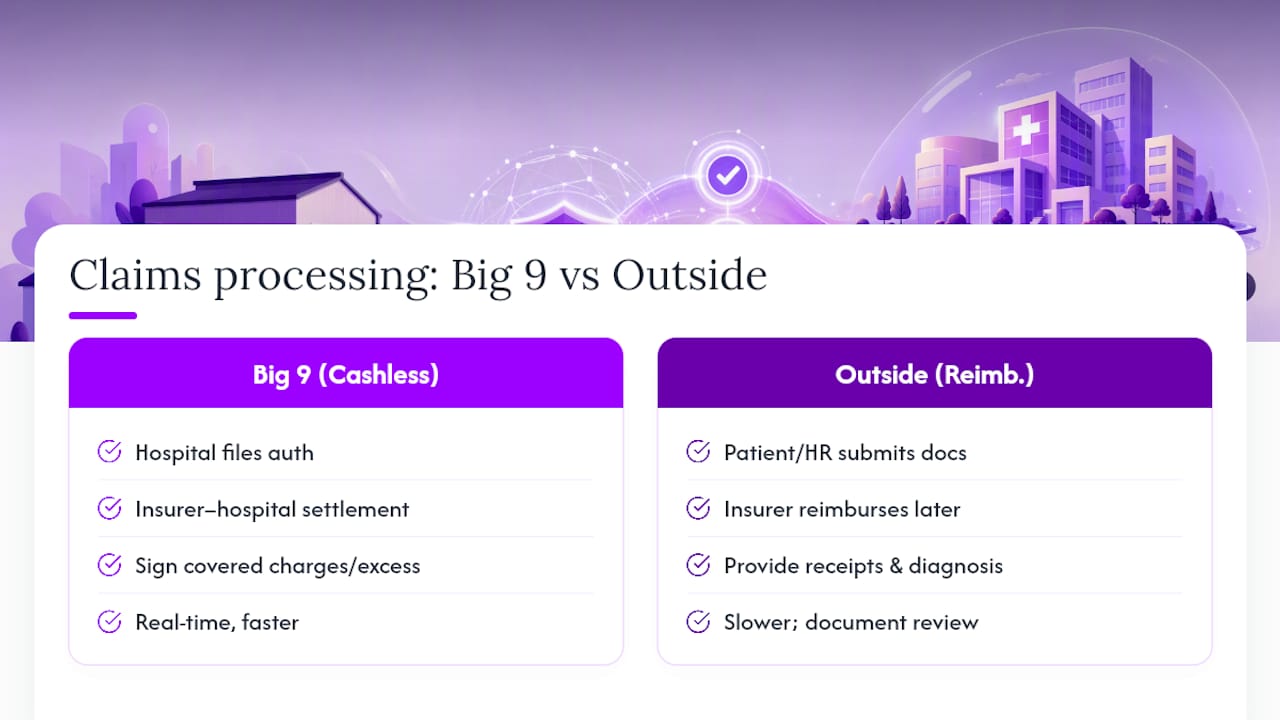
At a non-Big 9 or out-of-network facility, the claim shifts to a reimbursement model. The patient (or HR, for company-filed claims) submits official receipts, a diagnosis summary, and a claim form, then waits for the insurer’s processing and payout based on the plan’s benefit schedule rather than the full billed amount. Processing time for reimbursement claims typically runs longer than cashless settlement, since it involves document review rather than a real-time authorization check.
The practical difference for HR is workload. Cashless claims at Big 9 hospitals generate almost no paperwork for the company. Reimbursement claims at outside facilities generate a steady trickle of forms, follow-ups, and occasional disputes over what counts as a covered expense. This is a strong argument for confirming Big 9 accreditation status before, not after, a major procedure gets scheduled.
What Are Patient Rights When Using Big 9 Hospitals Under HMO Plans?
Employees have a right to a clear, upfront explanation of their room-class entitlement, covered services, and any excess charges before treatment begins, not after discharge. Hospitals and insurers are both expected to disclose authorization status in advance for non-emergency admissions, which means a patient can and should ask for written confirmation of coverage before agreeing to a procedure.
Patients also carry responsibilities that directly affect whether coverage holds up. Presenting the HMO card and a valid ID at admission, disclosing pre-existing conditions honestly during enrollment, and following the required pre-authorization steps for planned procedures all matter. Skipping any of these steps is one of the most common reasons a claim gets delayed or denied even at a fully accredited Big 9 hospital.
If a claim is denied or a room-class dispute arises, employees have the right to request a written explanation from the insurer and to appeal through the HMO’s formal grievance process. Keeping copies of admission forms, authorization letters, and billing statements gives HR and the employee something concrete to escalate with if a dispute drags on.
What HR Teams Get Wrong About Big 9 Access
The biggest mistake I see SME buyers make is treating a Big 9 hospital list on an insurer’s website as a settled fact rather than a claim that needs checking. Lists get copied from one marketing page to another for years after the underlying accreditation has quietly lapsed. If a specific hospital matters to your workforce, verify it directly with the insurer and the hospital, every renewal cycle, not just at signup.
The second mistake is confusing “the hospital is on the list” with “my plan tier gets full benefits there.” Room-class limits and specialist accreditation vary within the same hospital depending on which plan tier your company bought, and that detail rarely makes it into the sales pitch.
The third is underestimating how much authorization turnaround time matters. A plan that lists every Big 9 hospital but takes days to confirm pre-authorization isn’t actually more useful to your employees than a smaller network with same-day turnaround. Before signing anything, pilot-test the member services line yourself. Call with a realistic question and time how long it takes to get a straight answer.
If Big 9 access is a genuine procurement requirement for your company, put it in writing during the sales process and get the insurer to confirm it in the contract, not just verbally.
— Eumir
How HMO Plans Helps SMEs Get Verified Big 9 Access
Hmoplans exists for exactly the problem this article walks through: getting real, verifiable cashless access to premier hospitals without spending weeks chasing down directory confirmations yourself. Through the Purple Cow and Etiqa underwriting partnership, plans come with cashless admission at accredited Big 9 hospitals and Healthway Clinics, a 100% coverage commitment for pre-existing and congenital conditions up to the Maximum Benefit Limit, and add-ons like dental, annual physical exams, and life and accident coverage that let you shape one plan around your actual workforce instead of buying separate policies.
Before reaching out, have three things ready: your total employee count, the hospitals your team actually uses most (not just the ones that sound impressive), and your target Maximum Benefit Limit based on realistic admission costs. That information lets the Hmoplans team map a plan to your workforce instead of selling you a generic tier. Review the full feature set on the Purple Cow Premium page and reach out to get a plan proposal built around the hospitals your employees will actually walk into.
FAQ
What Is the Top HMO in the Philippines?
There is no single official ranking of “the top” HMO in the Philippines, since performance depends on network fit, claims turnaround, and pricing for your specific workforce. The more useful question for an SME is which plan reliably covers the hospitals your employees actually use, verified directly with the insurer rather than judged by brand recognition alone.
What Are the Big 9 Hospitals in the Philippines?
The Big 9 typically refers to a group of premier Metro Manila hospitals commonly cited in HMO marketing, including Makati Medical Center, St. Luke’s Medical Center BGC and Quezon City campuses, The Medical City, Asian Hospital and Medical Center, and Cardinal Santos Medical Center. The exact nine names can vary slightly between insurers, since it’s an industry shorthand rather than an official government list.
How Do I Know If My HMO Plan Currently Covers a Big 9 Hospital?
Check the insurer’s live online directory, then call both member services and the hospital’s admissions office directly to confirm accreditation and room-class entitlement. Marketing pages and older brochures can list hospitals that are no longer active in the network, so a direct phone confirmation is the only reliable check.
Is Kaiser or Maxicare the Better HMO Choice?
Neither Kaiser nor Maxicare operates the same way in the Philippine market as US-style HMO comparisons might suggest, and the better fit for an SME depends on which specific hospitals and services matter to your workforce rather than brand name alone. Compare Maximum Benefit Limits, active Big 9 hospital accreditation, and administrative features like digital claim submission before deciding based on reputation alone.
Does HMO Plans Include Big 9 Hospital Access?
Yes, Hmoplans offers cashless access to premier hospitals including the Big 9 network and Healthway Clinics, underwritten through the Purple Cow and Etiqa partnership. Coverage details, including the current Maximum Benefit Limit and room-class entitlements by plan tier, are available on the features page.
