

Nationwide HMO Access Guide for Philippine SMEs
TL;DR:
- Nationwide HMO access allows employees of SMEs to receive healthcare services through contracted networks across multiple regions. Selecting a plan based on network breadth, department coverage, and cost-sharing ensures better value and fewer claim issues. Proper employee education on referral rules and regular network verification help maximize benefits and reduce claim denials.
Nationwide HMO access is the process by which SMEs provide comprehensive, cost-effective healthcare for employees through managed care networks that coordinate services via primary care providers within defined geographic areas. For Philippine businesses, this structure matters because it directly controls what your employees can access, where they can go, and what your company pays. This nationwide HMO access guide covers how HMO networks operate, how to evaluate and select the right plan, how to use your benefits correctly, and how to avoid the most common pitfalls that cost SMEs money and employee goodwill.
What are the fundamentals of HMO healthcare coverage nationwide?
HMO coverage is built on a network of contracted hospitals, clinics, and physicians who agree to provide care at pre-negotiated rates. That network structure is what keeps premiums lower than other plan types. HMO Silver-tier plans average $674 per month versus $789 per month for PPO Silver-tier plans. That difference adds up fast across a team of 20 or 50 employees.

The core of any HMO is the primary care physician, or PCP. A PCP coordinates all member care within the network, including referrals to specialists, which prevents duplicate tests and keeps costs predictable. Think of the PCP as the traffic controller for your employee’s healthcare. Without that coordination, employees may seek care outside the network and trigger out-of-pocket costs the plan will not cover.
Referrals are required for most specialist visits, but the rules have exceptions. Open-access HMOs allow direct specialist scheduling without a PCP referral, and services like emergency care, OB/GYN visits, and mental health consultations are often exempt from referral requirements. Knowing which category your plan falls into determines how much administrative friction your employees face day to day.
HMO members face lower premiums and predictable copays but must stay within the network and obtain referrals, unlike PPO members who pay more for broader provider choice. For most Philippine SMEs managing tight benefits budgets, the HMO structure delivers the better value. The trade-off is network discipline: employees must understand the rules or the savings disappear in denied claims.
Pro Tip: Print a one-page summary of your HMO’s referral rules and emergency exceptions, and distribute it to every employee at enrollment. Most claim denials come from employees who did not know the rules, not from plan gaps.
How to evaluate and select the right nationwide HMO plan for your SME
Choosing an HMO plan based on premium alone is the most expensive mistake an SME can make. Covered services and network breadth matter more than price because the lowest-premium plan may exclude the specialists or drugs your employees actually need, resulting in higher total costs. Start your evaluation with the network, not the price sheet.
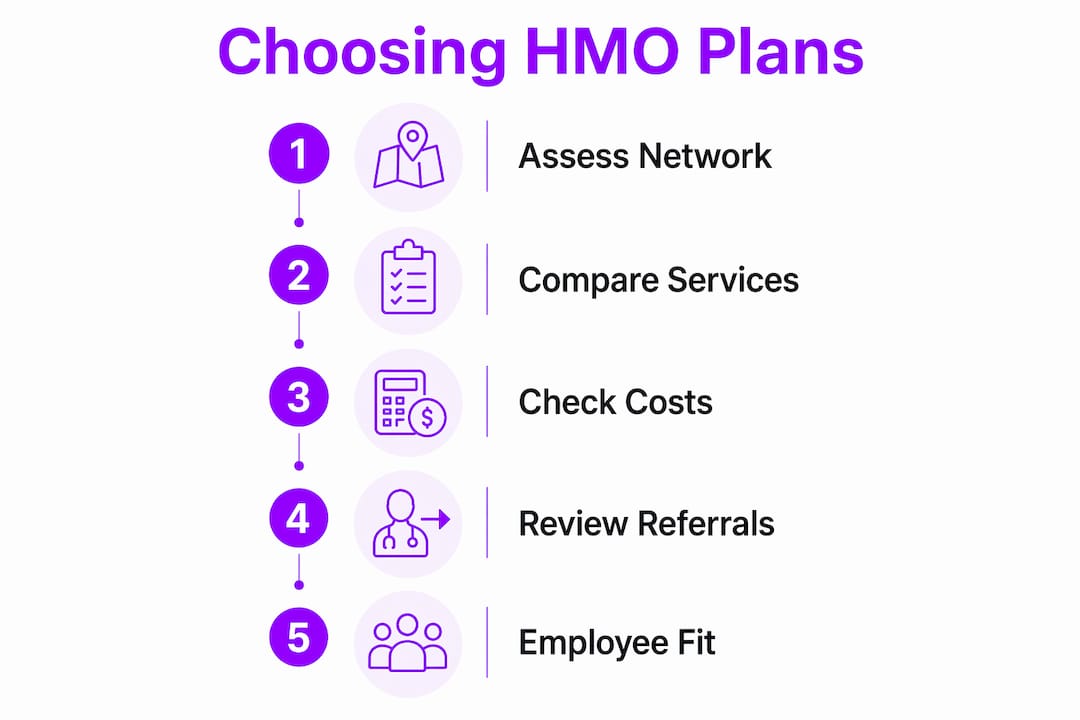
Criteria that determine real plan value
Assess these factors before signing any HMO contract:
- Network breadth: Does the plan cover hospitals and clinics in every city or province where your employees live and work? A plan that covers Metro Manila but not Cebu or Davao fails distributed teams.
- Hospital department coverage: Confirm coverage at the department level, not just the facility. Some hospital departments are not contracted even when the hospital itself is listed in the network. An employee needing oncology or cardiac surgery at an in-network hospital may still face out-of-network charges.
- Drug formulary: Review which medications are covered. Employees managing chronic conditions need their maintenance drugs on the formulary or they pay out of pocket.
- Specialist access policies: Determine whether the plan requires PCP referrals for every specialist visit or operates as an open-access HMO.
- Cost-sharing structure: Compare premiums, copays, and deductibles across plan tiers. Lower premiums with high copays can cost more annually for employees who use care frequently.
Matching the plan to your workforce
Comparing HMO plans requires examining network breadth, quality ratings, cost-sharing, and drug formularies beyond just premiums. Survey your employees before open enrollment. Ask about existing specialists they see, maintenance medications, and geographic locations where they regularly seek care. That data tells you which plan features are non-negotiable versus nice-to-have.
For a practical framework on comparing HMO plans for SMEs, cross-reference network directories against your employee survey results before finalizing any decision.
Pro Tip: Request a sample Explanation of Benefits document from the HMO provider before signing. It shows exactly how claims are processed and what employees will owe after coverage applies.
Step-by-step process for accessing and using nationwide HMO benefits
Getting enrolled is only the first step. Employees who do not understand how to use their HMO correctly generate the most complaints and the most denied claims.
Enrollment and setup
- Gather documentation. Collect employee identification, dependent information, and any pre-existing condition disclosures required by the plan. Hmoplans covers pre-existing conditions up to the Maximum Benefit Limit, which removes one of the most common enrollment barriers for SME teams.
- Select a primary care physician. Each employee must choose a PCP from the network directory. Encourage employees to call the clinic directly to confirm the physician is accepting new patients under the specific HMO plan. Directory listings are not always current.
- Register dependents. If the plan covers dependents, submit their documents during the enrollment window. Late additions may require a waiting period.
- Receive member cards and digital access. Confirm that each employee receives their physical or digital member card before the coverage start date. Without it, cashless access at accredited facilities may be delayed.
Using your benefits day to day
- Schedule through your PCP first. For non-emergency care, contact the PCP to initiate any specialist referral. This step protects the employee from out-of-network charges.
- Verify provider status before every visit. Call the provider’s office and confirm they are currently contracted with your specific HMO plan. This takes two minutes and prevents claim denials.
- Use the network directory for hospital selection. In non-emergency situations, choose from the plan’s accredited hospital list. Hmoplans provides access to premier facilities including the Big 9 Hospitals and Healthway Clinics, giving employees strong options across the country.
- File claims promptly. For any out-of-network emergency reimbursement, submit documentation within the plan’s required timeframe. Late submissions are the second most common reason reimbursements are denied.
- Use digital platforms. Many HMO plans now offer digital access for scheduling, claims tracking, and teleconsultation. Hmoplans provides a digital healthcare platform that reduces the friction of accessing care, especially for employees in remote locations.
For a detailed walkthrough on how to choose SME HMO plans and set up employee benefits correctly, review the step-by-step guidance tailored to Philippine business requirements.
Common challenges with nationwide HMO access and how to overcome them
The most frequent complaint SMEs raise about HMO plans is not the coverage itself. It is the gap between what the plan promises and what employees experience when they try to use it.
Provider directory errors
About 50% of Medicare Advantage directories contained errors, and the same problem affects commercial HMO directories in the Philippines. A provider listed in the directory may have left the network, retired, or stopped accepting new patients. The fix is direct phone verification. Train your HR team and employees to call the provider’s office before every first visit to confirm active participation.
Network gaps for traveling employees
Employees who travel frequently between regions face real access problems with plans that have thin provincial networks. Before selecting a plan, map your employee locations and travel patterns against the network directory. Plans with 24/7 nationwide coverage, like those offered through Hmoplans, address this by maintaining accredited providers across multiple regions rather than concentrating coverage in Metro Manila.
Referral delays
Referral requirements add time between a symptom and specialist care. Standing referral policies allow employees with chronic conditions to see their specialist repeatedly without new authorizations each time. When evaluating plans, ask specifically whether standing referrals are available for chronic disease management. This single feature significantly reduces administrative burden for employees managing diabetes, hypertension, or similar conditions.
Unexpected out-of-pocket costs
The most surprising bills come from in-network hospitals where specific departments are not contracted. An employee admitted to an accredited hospital for cardiac care may find that the cardiology department operates outside the plan’s network. Verify hospital coverage at the department level for any specialized treatment, not just at the facility level.
Pro Tip: Create a short verification checklist for employees: confirm the hospital is in-network, confirm the specific department is contracted, and confirm the attending physician is an active plan participant. All three must be true for full coverage to apply.
- Audit your network directory every six months, not just at renewal.
- Establish a direct HR contact for claim disputes so employees are not navigating denials alone.
- Review your plan’s out-of-network reimbursement policy so employees know what to do in genuine emergencies outside the network.
For a complete HMO provider selection checklist built for Philippine SMEs, use it as a reference before your next renewal cycle.
Key Takeaways
The most effective nationwide HMO strategy for Philippine SMEs combines thorough network verification, employee education on referral rules, and plan selection based on workforce health profiles rather than premium price alone.
| Point | Details |
|---|---|
| Network verification is non-negotiable | Call providers directly to confirm active participation before every first visit. |
| Department-level coverage matters | Confirm specific hospital departments are contracted, not just the facility. |
| Standing referrals reduce friction | Request standing referral policies for employees managing chronic conditions. |
| Workforce data drives plan selection | Survey employees on specialists and medications before choosing a plan. |
| Digital access improves utilization | Plans with digital platforms reduce barriers for employees in remote locations. |
Why I think most SMEs are choosing HMO plans the wrong way
The conventional advice is to compare premiums, pick the lowest one that covers your headcount, and move on. I have seen that approach fail repeatedly, and the failure always looks the same: an employee gets a denied claim, HR spends weeks resolving it, and leadership questions whether the HMO is worth the cost.
The real problem is that most SMEs treat HMO selection as a procurement exercise rather than a benefits design decision. Price matters, but the misconception that HMOs offer inferior care is just as damaging as overpaying. Coordinated care through a primary provider produces better health outcomes and lower long-term costs when the plan is set up correctly and employees actually understand how to use it.
What I have found works is treating the first 90 days of a new HMO plan as an active implementation period. HR should run a brief orientation, distribute a one-page reference card on referral rules and emergency procedures, and set up a simple process for employees to ask questions before they need care. That investment of a few hours prevents months of claim disputes.
HMOs suit employees who prefer predictable low copays and fixed costs, while employees who travel extensively or need frequent specialist access may find the network restrictions limiting. Acknowledging that reality and building a plan that fits your actual workforce is the difference between a benefits program that retains talent and one that generates complaints.
Review your HMO plan annually. Workforce health needs change, network contracts change, and the plan that worked in 2024 may have gaps in 2026. Proactive review costs far less than reactive claim resolution.
— Eumir
Hmoplans and Purple Cow: nationwide HMO coverage built for SMEs
Philippine SMEs looking for a straightforward HMO solution with genuine nationwide reach have a clear option in Hmoplans, powered by Purple Cow and underwritten by Etiqa.
Hmoplans covers pre-existing conditions, congenital conditions, and special procedures up to the Maximum Benefit Limit, with no complicated exclusion clauses that leave employees unprotected when they need care most. The plan includes cashless access to accredited providers nationwide, including the Big 9 Hospitals and Healthway Clinics, plus out-of-network reimbursements for genuine emergencies. Optional add-ons include dental HMO services, annual physical exams, and life and accident insurance. SMEs can also access member services support to manage enrollment, claims, and employee queries without the administrative burden that typically slows down smaller HR teams.
FAQ
What is nationwide HMO access for SMEs?
Nationwide HMO access means your employees can receive covered healthcare services through a contracted network of hospitals, clinics, and physicians across multiple regions. The plan coordinates care through a primary care physician to manage costs and service quality.
How does an HMO differ from a PPO for employee benefits?
HMO plans offer lower premiums and predictable copays but require employees to use in-network providers and obtain referrals. PPO plans provide broader provider choice at higher cost, making HMOs the more cost-effective option for most Philippine SMEs.
What should SMEs verify before selecting an HMO plan?
Verify network breadth across all employee locations, hospital coverage at the department level, drug formulary completeness, and whether the plan offers standing referrals for employees with chronic conditions. Use a provider selection checklist to avoid missing critical criteria.
How do employees access specialist care under an HMO?
Employees typically request a referral from their primary care physician, who then authorizes the specialist visit. Open-access HMOs allow direct specialist scheduling, and services like emergency care and OB/GYN visits are usually exempt from referral requirements.
What causes most HMO claim denials for SME employees?
The most common causes are using out-of-network providers without prior authorization, visiting in-network hospitals where the specific department is not contracted, and submitting reimbursement claims after the plan’s filing deadline.
