

HMO Add-On Services Guide for Philippine SMEs
TL;DR:
- HMO add-on services are optional benefits that expand employee coverage beyond standard plans and PhilHealth. SMEs should map PhilHealth benefits first, request detailed service lists, and negotiate customization to avoid duplication and ensure cost-effective coverage. Carefully assess the necessity of POS riders and wellness programs, focusing on genuine gaps to build a tailored, comprehensive health package.
HMO add-on services are supplemental health benefits that extend employee coverage beyond what standard HMO plans and PhilHealth provide. For SME employers in the Philippines, these optional riders and benefit expansions fill the gaps that basic coverage leaves open. This guide to HMO add-on services covers the most common types available, how to align them with your existing PhilHealth benefits, the real financial tradeoffs of options like point-of-service riders, and a practical framework for selecting and negotiating the right package for your team.
What are the common types of HMO add-on services?
HMO service add-ons are optional benefit layers that sit on top of a base HMO plan. They are purchased separately, priced individually, and governed by their own contractual rules. Understanding what each type covers is the first step toward building a benefit package your employees will actually use.
Annual Physical Exam (APE) Add-Ons
The APE add-on is one of the most requested examples of HMO add-on services among Philippine SMEs. A well-structured APE package specifies exact components rather than vague “check-up” language. For example, MaxiHealth’s PRIMA plan bundles an APE covering a complete blood count, urinalysis, fecalysis, chest X-ray, and unlimited clinic consultations. That level of specificity matters because it tells you exactly what your employees receive and prevents disputes at the point of service.
Dental HMO Add-Ons

Dental coverage is rarely included in a base HMO plan. A dental add-on typically covers preventive services like cleaning and X-rays, plus basic restorative procedures. For SMEs looking to make dental coverage work harder, the dental HMO benefits guide from Hmoplans breaks down how to structure dental riders for maximum employee value without overpaying for procedures your workforce is unlikely to use.
Point-of-Service (POS) Riders
A POS rider allows an HMO member to self-refer out-of-network at higher cost-sharing. Think of it as a conditional escape valve from your HMO’s closed network. The tradeoff is real: employees gain provider flexibility, but they absorb higher out-of-pocket costs when they use it.
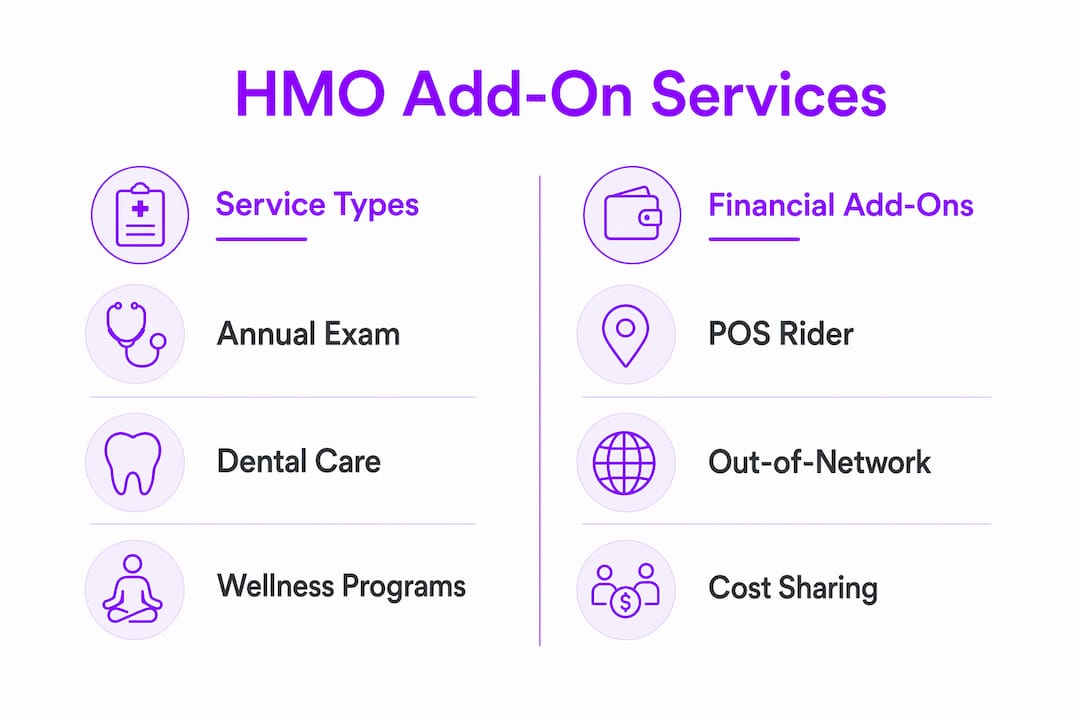
Wellness and Preventive Program Add-Ons
Wellness add-ons include gym discounts, mental health screenings, and chronic disease management programs. These often require separate enrollment and vary significantly by plan contract. They are not automatic inclusions, so you need to ask for them explicitly during plan negotiations.
Pro Tip: Ask your HMO provider for a written list of every add-on available before you start negotiating. Many providers only present their most popular options unless you ask for the full catalog.
How do HMO add-ons align with PhilHealth coverage?
The biggest mistake SME employers make is paying for add-ons that duplicate what PhilHealth already covers. Mapping your PhilHealth benefits first saves money and sharpens your add-on selections.
PhilHealth’s YAKAP program and Konsulta framework already include outpatient consultations, laboratory tests, cancer screening, and preventive oral health services. PhilHealth expanded outpatient drug coverage to 75 essential medicines under YAKAP. That is a meaningful national floor, and any add-on that duplicates those medicines or those screenings is wasted premium.
The smarter approach is to treat PhilHealth as your baseline and build add-ons around what it does not cover. PhilHealth’s expanded preventive benefits include preventive oral health, but they do not cover restorative dental work, orthodontics, or specialist dental procedures. That gap is exactly where a dental HMO add-on earns its cost.
Here is a practical checklist for avoiding duplication:
- List every service covered under your employees’ PhilHealth membership, including YAKAP and Konsulta benefits
- Cross-reference that list against every add-on you are considering
- Flag any overlap and either remove the add-on or negotiate a reduced scope
- Confirm which PhilHealth benefits require accredited facility visits and whether your HMO network satisfies those requirements
Pro Tip: Request a side-by-side comparison from your HMO provider showing their add-on benefits next to PhilHealth coverage. Providers who cannot produce this document are not ready to serve SME clients well.
For a deeper look at how PhilHealth and private HMO coverage interact, the PhilHealth and HMO guide from Hmoplans is a practical starting point.
What are the tradeoffs of POS riders and other financial add-ons?
The point-of-service rider is the most financially complex of all add-on services for HMOs. Getting it wrong costs your company money without delivering proportional value to employees.
| Factor | In-Network HMO Care | POS Rider (Out-of-Network) |
|---|---|---|
| Cost to employee | Low or zero copay | Higher copay or coinsurance |
| Provider choice | Limited to accredited network | Any licensed provider |
| Referral required | Yes, through primary care physician | Self-referral allowed |
| Premium impact | Included in base plan | Additional rider cost |
| Best suited for | Routine and specialist care | Employees with established outside providers |
POS riders are best suited when employees already have established care relationships outside the HMO network. If your workforce is young, generally healthy, and has no strong provider preferences, the rider premium becomes pure cost with little utilization to justify it.
The financial logic is straightforward. If your team is unlikely to use out-of-network providers, the rider premium adds to your total benefit spend without adding perceived value. If several employees have ongoing specialist relationships outside your HMO’s accredited list, the rider pays for itself in goodwill and retention.
HMO add-ons operate under separate contractual rules, and missing procedural gates like required primary care physician referrals or exceeding out-of-network limits can cause benefit losses even when the add-on contract is active. Employees who do not understand these rules will blame the employer when claims are denied.
Pro Tip: Before adding a POS rider, survey your employees about their current provider relationships. If fewer than 20% have an established out-of-network provider, the rider is likely not worth the premium.
How should philippine smes select and negotiate HMO add-on packages?
Selecting the right add-on services for HMOs is a structured process, not a shopping exercise. Follow these steps to make decisions your finance team and your employees will both appreciate.
-
Assess your workforce health profile. Review any available claims data from your current plan. Identify which services employees use most and which gaps generate the most complaints. High dental claims complaints signal a dental add-on is overdue. Frequent out-of-network reimbursement requests signal a POS rider may be worth evaluating.
-
Map existing coverage before adding anything. List all PhilHealth benefits your employees currently access, including YAKAP and Konsulta services. Any add-on that duplicates a PhilHealth benefit is a cost you can eliminate or reduce.
-
Request itemized service component lists. Employers should request an itemized list specifying exact tests, frequency, and care settings for every add-on under consideration. Vague descriptions like “comprehensive physical exam” are not acceptable contract language. You need to know whether that exam includes a lipid panel, an ECG, or a fasting blood glucose test.
-
Confirm accreditation and clinical settings. When negotiating add-ons, clarify accreditation status and the clinical settings where services will be delivered. An APE add-on that only works at one clinic location in Metro Manila is not useful for a team spread across Cebu, Davao, and Pampanga.
-
Evaluate cost-sharing structures. Understand what your employees will pay out of pocket when they use each add-on. High employee cost-sharing reduces utilization, which defeats the purpose of offering the benefit in the first place.
-
Integrate wellness add-ons strategically. Preventive wellness add-ons enhance employee satisfaction and can reduce longer-term utilization by promoting healthier behavior. Budget for at least one wellness component, whether that is a mental health screening program or a chronic disease management track, as a long-term investment in lower claims.
-
Negotiate customization explicitly. HMO providers expect negotiation from SME clients. Ask for specific service components to be added or removed. Ask for frequency limits to be adjusted. Ask for the accredited facility list to be expanded. Providers who refuse all customization are not the right fit for an SME with specific workforce needs.
For a practical framework on customizing HMO benefits for your team, Hmoplans provides step-by-step guidance tailored to Philippine SME conditions.
Key takeaways
The most effective approach to HMO add-on services is to map PhilHealth coverage first, select add-ons that fill genuine gaps, and negotiate itemized service lists before signing any contract.
| Point | Details |
|---|---|
| Define add-ons precisely | Request itemized service lists with exact tests, frequency, and care settings before committing. |
| Avoid PhilHealth duplication | Map YAKAP and Konsulta benefits first to eliminate redundant add-on spending. |
| Evaluate POS riders carefully | Only add a POS rider if employees have established out-of-network provider relationships. |
| Invest in wellness add-ons | Preventive programs reduce long-term claims and improve employee satisfaction measurably. |
| Negotiate every component | HMO providers expect customization requests from SME clients. Ask explicitly for what you need. |
Why most smes get HMO add-ons wrong
I have seen the same mistake repeated across dozens of SME benefit reviews. The employer picks an add-on package based on what sounds good in a sales presentation, signs the contract, and then discovers six months later that half the benefits are inaccessible because of referral requirements nobody explained to employees.
The coverage dispute is almost always traceable to one root cause: the employer never asked for the actual service component list. They accepted a benefit name, not a benefit definition. “Dental coverage” and “dental coverage including two cleanings, two X-rays, and one filling per year at any accredited clinic” are completely different products. Only one of them sets clear expectations.
POS riders are the other common trap. They sound like a generous employee perk, but for most SME workforces in the Philippines, the utilization rate does not justify the premium. I would only recommend a POS rider for companies where a meaningful portion of the team has long-standing relationships with specialists outside the HMO network, such as oncologists or cardiologists they have been seeing for years.
The preventive wellness add-ons, on the other hand, are chronically underused by SMEs and consistently undervalued. A mental health screening program or a chronic disease management track costs far less than the downstream claims it prevents. The ROI is real, even if it takes two to three years to show up in your claims data.
The bottom line: treat your HMO add-on package as a contract negotiation, not a product purchase. Read every line. Ask for every clarification. And align everything with what PhilHealth already provides before you spend a single additional peso.
— Eumir
How Hmoplans helps smes build smarter HMO packages
Hmoplans, powered by Purple Cow and underwritten by Etiqa, is built specifically for Philippine SMEs that need flexible HMO coverage without complicated terms. Their HMO plan features include optional add-ons for dental HMO services, annual physical exams, and life and accident insurance, all customizable to your workforce size and health profile.
What sets Hmoplans apart is the 100% coverage commitment for pre-existing conditions, congenital conditions, and special procedures, all up to the Maximum Benefit Limit. Their team supports SME employers through the full add-on selection process, from mapping PhilHealth coverage to negotiating specific service components. If you are ready to build a benefit package your employees will actually use, explore Hmoplans member services to see how their team can help you get there.
FAQ
What are HMO add-on services?
HMO add-on services are optional supplemental benefits purchased on top of a base HMO plan, covering services like dental care, annual physical exams, wellness programs, and out-of-network access through point-of-service riders.
How do HMO add-ons differ from PhilHealth benefits?
PhilHealth covers a defined set of preventive and outpatient services under programs like YAKAP and Konsulta, while HMO add-ons extend coverage into areas PhilHealth does not reach, such as restorative dental work, specialist physical exams, and gym or mental health programs.
Is a point-of-service rider worth the extra premium?
A POS rider is worth the cost only when employees have established care relationships outside the HMO network. For workforces without strong out-of-network provider preferences, the rider premium typically exceeds its utilization value.
What should employers ask for when negotiating HMO add-ons?
Employers should request an itemized service component list specifying exact tests, frequency, and care settings, plus confirmation of accredited facility locations, to avoid ambiguity and coverage disputes after the contract is signed.
Can smes customize their HMO add-on packages?
Yes. HMO providers expect SME clients to negotiate add-on components. Employers can request specific services to be added or removed, frequency limits to be adjusted, and accredited facility lists to be expanded based on workforce location and health needs.
