

HMO Cost Management Guide for Philippine SMEs
TL;DR:
- HMO cost management for Philippine SMEs involves understanding cost components, employer-side controls, and integrating PhilHealth contributions into the total health budget. Strategic plan design, workforce segmentation, and operational discipline help control claims volatility and maximize savings. Proper comparison of plans and continuous data monitoring are essential to avoid costly cost overruns and maintain quality care.
HMO cost management is the practice of controlling total employer health insurance spend by understanding plan cost structures, applying strategic plan design, and coordinating private HMO benefits with PhilHealth contributions. For small and medium enterprise (SME) owners in the Philippines, this is not optional financial hygiene. Health benefits are often the second-largest people cost after salaries, and without a structured HMO budgeting guide, premiums and claims can spiral well beyond initial projections. This article breaks down every cost component, explains the employer levers that actually move the needle, and shows you how to integrate PhilHealth into a coherent cost model.
What are the key components of HMO costs for SME budgeting?
Total annual HMO costs combine fixed annual premiums with expected employee cost-sharing, capped by the plan’s out-of-pocket maximum. This formula matters because it means your actual employer exposure is not just the premium line on your invoice. It includes every peso your employees spend before hitting their ceiling, which ultimately affects absenteeism, satisfaction, and retention.
The four cost-sharing layers you need to understand are:
- Annual premium. The fixed amount you pay per covered employee regardless of whether they use the plan. For Philippine SMEs, premiums are typically calculated by age band, benefit limit, and group size. A younger workforce in a tech company pays meaningfully less than a mixed-age group in manufacturing.
- Copayment. A flat fee the employee pays per visit or service, such as ₱200 per outpatient consultation. Copayments, deductibles, and coinsurance are the core cost-sharing layers that determine employee out-of-pocket spending. High copays reduce claims volume but can discourage employees from seeking early care, which drives up costs later.
- Deductible. The amount an employee pays before the HMO begins covering costs. Deductibles are less common in Philippine HMO products than in U.S.-style plans, but some supplemental or reimbursement-based plans include them.
- Coinsurance. The percentage split between employee and insurer after the deductible is met. A 20% coinsurance on a ₱50,000 procedure means the employee pays ₱10,000.
- Out-of-pocket maximum. The ceiling on total employee cost-sharing per year. Once hit, the plan covers 100% of eligible costs. This is your primary tool for predicting worst-case employer exposure.
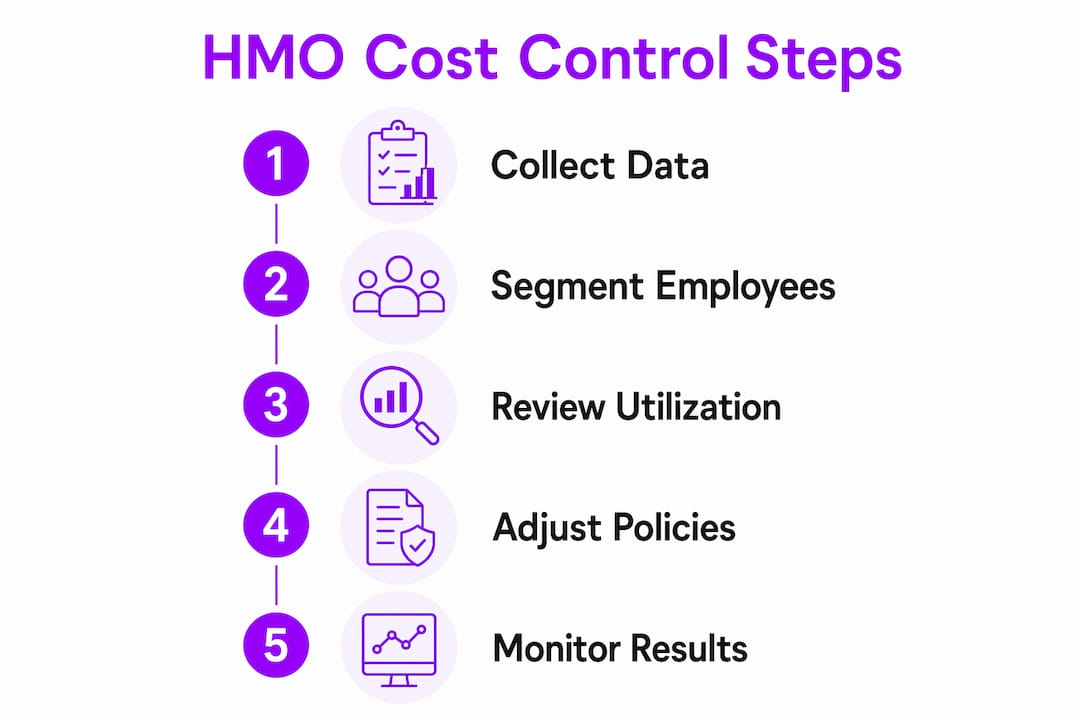
To model costs accurately, segment your workforce by utilization level. Low-utilization employees (healthy, rarely visit doctors) cost close to the premium alone. Moderate-utilization employees add copays and occasional specialist visits. High-utilization employees, those managing chronic conditions or requiring surgery, can reach the out-of-pocket maximum and trigger significant claims. Segmenting by utilization level enables more accurate cost projections and avoids the trap of average-based budgeting, which consistently underestimates exposure.
Pro Tip: Build a simple three-scenario model in a spreadsheet: low, moderate, and high utilization. Multiply each scenario by the number of employees you estimate fall into each category. This gives you a realistic cost range, not just a best-case number.

Which employer strategies control HMO costs without cutting care quality?
HMOs deliver employer cost advantages through negotiated provider discounts, primary care physician (PCP) gatekeeping, capitation payment models, and preventive care emphasis. Each of these mechanisms reduces claims volatility in a different way, and understanding them helps you choose plans and providers that actually deliver savings.
Here are the most effective HMO cost control strategies for Philippine SME employers:
- Leverage negotiated network discounts. Accredited HMO providers accept pre-agreed rates that are significantly lower than walk-in fees. When your employees stay in-network, every consultation, lab test, and procedure is billed at the contracted rate. Out-of-network use destroys this advantage immediately.
- Enforce PCP gatekeeping. Plans that require a PCP referral before specialist visits reduce unnecessary specialist consultations, which are among the highest-cost claims categories. Educate employees that skipping the PCP is not a shortcut. It is a cost multiplier.
- Understand capitation models. Under capitation, the HMO pays providers a fixed monthly fee per enrolled member regardless of services rendered. This incentivizes providers to keep members healthy and avoid unnecessary procedures. Plans built on capitation tend to have more stable premiums over time.
- Invest in preventive care. Annual physical exams, health screenings, and wellness programs catch conditions early. Treating hypertension with medication costs a fraction of treating a stroke. Many Philippine HMO plans, including those offered through Hmoplans, include annual physical exams as an add-on precisely because the long-term cost math favors prevention.
- Use clinical management programs. 64% of CFOs place strong emphasis on clinical management as a key lever for sustainable cost control. These programs coordinate care for high-cost, high-need employees, reducing duplicate tests and unnecessary hospitalizations.
Pro Tip: Ask your HMO provider for a utilization report at the six-month mark. If a small number of employees account for a disproportionate share of claims, targeted wellness interventions for that group can reduce your renewal premium.
Sustainable healthcare cost management depends more on operational efficiency and appropriate resource use than on blunt premium cuts. Cutting benefits to save money in year one often increases costs in year two through higher absenteeism and delayed care.
How can Philippine SMEs integrate PhilHealth and private HMO plans?
PhilHealth contributions are set at a statutory 5% premium rate, applied to monthly salary with a ₱10,000 floor and a ₱100,000 ceiling. This means the minimum combined employer-employee contribution is ₱500 per month, and the maximum is ₱5,000 per month. These are mandatory costs that belong in your total health benefits budget, not a separate HR line item.
The table below maps how PhilHealth and private HMO coverage interact across the three main care categories:
| Care category | PhilHealth coverage | Private HMO coverage |
|---|---|---|
| Inpatient (hospitalization) | Case rate packages for listed conditions | Room and board, surgeon fees, ancillary services up to MBL |
| Outpatient | Limited to specific day surgeries and procedures | Consultations, diagnostics, pharmacy (plan-dependent) |
| Emergency | Covered under case rates if admitted | Emergency room access at accredited facilities |
The practical implication: PhilHealth covers a defined set of inpatient case rates, while your private HMO fills the gaps in room charges, professional fees, and outpatient care. Coordinating PhilHealth with private HMOs avoids redundant costs and administrative friction by clearly mapping coverage triggers and benefit scopes. Without this mapping, employees file claims incorrectly, reimbursements are delayed, and HR spends hours resolving disputes.
For budgeting purposes, calculate your total employer health cost as: PhilHealth employer share (2.5% of salary) plus private HMO premium per employee. A mid-level employee earning ₱30,000 per month generates a ₱750 PhilHealth employer contribution plus whatever HMO premium applies. Understanding the differences between PhilHealth and HMO coverage is the starting point for building an accurate cost model.
What are the best practices for comparing HMO plans at renewal?
HMO plan comparison requires evaluation of network adequacy, cost-sharing details, drug formularies, and premium contributions. Focusing solely on premiums is the single most common and costly mistake SME owners make at renewal time.
The comparison below illustrates why the lowest-premium plan is rarely the lowest-cost plan:
| Evaluation factor | Low-premium plan risk | What to look for instead |
|---|---|---|
| Network adequacy | Fewer accredited hospitals, forcing out-of-network use | Coverage at Big 9 Hospitals and Healthway Clinics |
| Out-of-pocket maximum | Higher ceiling means greater employee exposure | Confirm the cap and whether it includes all cost-sharing |
| Drug formulary | Narrow formulary increases employee pharmacy costs | Check coverage for your workforce’s common medications |
| Pre-existing conditions | Exclusions create gaps for high-utilization employees | 100% coverage up to MBL, as offered by Hmoplans via Purple Cow |
| Claims utilization data | Ignoring past claims leads to mispriced renewals | Request a utilization report before signing any renewal |
Premium-only comparison understates true employee spend. A plan with a ₱500 lower monthly premium but a ₱20,000 higher out-of-pocket maximum can cost your employees significantly more in a moderate-utilization year. Use your claims data from the prior year to model realistic total costs under each plan option.
A structured HMO plan comparison process for SMEs should also account for the HMO renewal process, including timelines, documentation requirements, and negotiation windows. Most providers allow plan adjustments 30 to 60 days before renewal. That window is your leverage point.
Pro Tip: Request a benchmark report from your broker or HMO provider showing how your claims ratio compares to similar-sized companies in your industry. If your ratio is below average, you have a strong negotiating position for a lower renewal premium.
How can employers avoid operational pitfalls that blow up HMO costs?
Operational failures are the hidden driver of HMO cost overruns. Employees bypassing HMO cost controls, whether by going out-of-network or skipping referral requirements, generate claims that are billed at full rates and often disputed. The fix is not punitive. It is procedural.
Follow these steps to build operational discipline into your HMO program:
- Write a one-page benefits SOP. Document the exact steps for outpatient visits, specialist referrals, emergency admissions, and reimbursement claims. Distribute it at onboarding and at every renewal. Most employees do not read their benefits booklet. A one-page process guide gets read.
- Train HR and finance together. HR manages employee queries; finance manages the claims budget. When they operate in silos, cost overruns go undetected until renewal. A quarterly joint review of claims data closes this gap.
- Monitor utilization monthly, not annually. Health-plan analytics should be an ongoing feedback loop, not a one-time event. Early detection of a spike in specialist referrals or emergency room visits allows you to intervene before costs compound.
- Segment communication by employee group. A 25-year-old employee needs different benefits education than a 45-year-old with a family. Targeted messaging improves compliance and reduces unnecessary utilization.
- Address high-utilizer impact directly. A single employee with a chronic condition can account for 20% to 30% of a small group’s total claims. Case management programs, often available through your HMO provider, coordinate care for these individuals and reduce duplicate or unnecessary services.
Pro Tip: Set a calendar reminder 90 days before your renewal date to pull your claims utilization report. Waiting until 30 days out leaves you no time to negotiate or restructure your plan design.
Key takeaways
Effective HMO cost management for Philippine SMEs requires understanding cost structures, applying employer-side controls, and integrating PhilHealth into a unified budget model.
| Point | Details |
|---|---|
| Model costs by utilization tier | Segment employees into low, moderate, and high utilization to avoid average-based budgeting errors. |
| Use HMO structural advantages | PCP gatekeeping, capitation, and preventive care reduce claims volatility more than premium cuts. |
| Integrate PhilHealth accurately | Add the 2.5% employer PhilHealth share to your per-employee HMO cost for a true total health budget. |
| Compare plans on total cost, not premium | Evaluate out-of-pocket maximums, network adequacy, and formularies alongside premium rates at renewal. |
| Build operational SOPs | Written referral and network-use procedures prevent the employee behavior that causes cost blow-ups. |
Why I think most SMEs are managing HMO costs from the wrong end
After working with SME owners across tech, hospitality, and healthcare in the Philippines, the pattern I see most often is this: the conversation starts and ends with the premium. The owner asks, “What is the cheapest plan?” and the broker answers with a number. Nobody talks about the out-of-pocket maximum, the network gaps, or the claims ratio from the prior year.
The uncomfortable truth is that the cheapest premium is often the most expensive plan once you factor in what employees actually spend. I have seen companies switch to a lower-premium plan to save ₱50,000 annually, only to face a renewal increase of ₱200,000 the following year because their claims ratio spiked. The spike was predictable. The utilization data was there. Nobody looked at it.
Clinical management emphasis consistently delivers cost control with less employee dissatisfaction than cost-sharing hikes or network restrictions. That finding aligns with what I observe locally. Employees do not resent wellness programs or care coordination. They resent being told their preferred hospital is not covered.
The other thing I would push back on is the idea that PhilHealth integration is an HR problem. It is a finance problem. The employer PhilHealth share is a real cost that belongs in your per-employee health budget. When finance and HR model benefits costs separately, the total is always wrong. Get them in the same room with the same spreadsheet.
My advice: treat your HMO program as a data asset. Pull utilization reports. Segment your workforce. Model three scenarios. Then negotiate from evidence, not from gut feel. That is how you control costs without gutting the benefits your employees actually value.
— Eumir
Tailored HMO plans built for Philippine SMEs
Managing HMO expenses is significantly easier when your plan is designed for how SMEs actually operate, not retrofitted from a corporate product. Hmoplans, powered by Purple Cow and underwritten by Etiqa, offers SME-specific HMO plans with 100% coverage for pre-existing conditions, congenital conditions, and special procedures up to the Maximum Benefit Limit. There are no complicated exclusion clauses to decode.
Access to the Big 9 Hospitals and Healthway Clinics, cashless transactions, and 24/7 nationwide coverage are standard. Optional add-ons including dental, annual physical exams, and life and accident insurance let you customize the plan to your workforce profile without paying for benefits your team does not need. Explore the full SME plan features to see how Hmoplans structures cost-effective coverage that your employees will actually use.
FAQ
What is an HMO cost management guide for SMEs?
An HMO cost management guide is a structured framework for understanding and controlling total employer health insurance spend, covering premiums, cost-sharing design, PhilHealth integration, and operational compliance. For Philippine SMEs, it translates plan mechanics into budget decisions.
How does PhilHealth affect my total HMO budget?
PhilHealth contributions are mandatory at 5% of monthly salary, split between employer and employee, with a salary floor of ₱10,000 and ceiling of ₱100,000. The employer share of 2.5% must be added to your private HMO premium to calculate the true per-employee health cost.
Why is comparing HMO plans by premium alone a mistake?
Premium-only comparison ignores out-of-pocket maximums, network adequacy, and drug formulary coverage, all of which determine actual total cost. A lower-premium plan with a higher out-of-pocket ceiling can cost employees significantly more in a moderate-utilization year.
What is the fastest way to reduce HMO costs without cutting benefits?
Enforcing PCP referral pathways and keeping employees in-network are the two fastest operational levers. Employees who bypass referrals or use out-of-network providers generate full-rate claims that eliminate the negotiated discount advantage built into every HMO plan.
How often should SMEs review their HMO utilization data?
Monthly monitoring is the standard recommended by SHRM and UnitedHealthcare for sustainable cost control. Reviewing data only at renewal leaves you reacting to cost spikes rather than preventing them.
