

Day 1 to 90 Days: Philippine HR Playbook for HMO Eligibility
HMO coverage for probationary employees in the Philippines is voluntary, not statutory. PhilHealth, SSS, and Pag-IBIG apply from Day 1 regardless of employment status, but private HMO enrollment depends on what your employer promises and practices. Once that promise appears in writing, a handbook, or a consistent pattern of enrolling probationary staff, it becomes a demandable benefit protected from unilateral withdrawal under Article 100 of the Labor Code.
TL;DR:
- Probationary employees are entitled to statutory benefits like PhilHealth, SSS, and Pag-IBIG from Day 1, regardless of employment status, but HMO coverage depends on employer promise or practice.
- An employer’s written HMO offer, handbook provision, collective bargaining agreement, or consistent enrollment pattern can make HMO benefits legally enforceable, protected from unilateral withdrawal.
- Staged eligibility options, such as coverage starting at hire or after a waiting period, are legal if clearly documented and uniformly applied, but inconsistent policies can lead to disputes.
- Employers should align HMO, PhilHealth, and payroll timing carefully, especially for mid-year hires, and document all policy details before implementation or changes.
- Flexible HMO plans with features like dependent add-ons and nationwide network access facilitate staged eligibility and easier compliance for SMEs managing complex timing and budgeting concerns.
Table of Contents
- Statutory Baseline vs Private HMO: What the Law Requires for Probationary Employees
- When an HMO Promise Becomes Enforceable
- Common Employer Policies and What Counts as Reasonable
- HR Checklist: Step-by-Step Actions to Implement or Change Probationary HMO Rules
- How Hmoplans Supports SMEs Implementing Staged Eligibility for Probationary Employees
- Impact of Probation Period Length Variations on HMO Eligibility
- Typical Waiting Periods or Exclusions for Pre-Existing Conditions During Probation
- Differences in HMO Coverage Levels or Benefit Restrictions for Probationary vs Regular Employees
- Case Studies or Examples Illustrating Disputes Over HMO Coverage for Probationary Staff
- Practical Advice for Probationary Employees: What Documents and Questions to Request
- Give Your Team the HMO Coverage Timeline They Can Actually Count On
- Sources
- FAQ
Statutory Baseline vs Private HMO: What the Law Requires for Probationary Employees
Probationary status changes almost nothing about your statutory benefits. The moment someone starts working, whether on a six-month probationary contract or a regular appointment, the employer owes them PhilHealth, SSS, and Pag-IBIG coverage. A DOLE advisory confirms that probationary employees are covered by labor standards just like regular staff, and employers cannot withhold statutory entitlements simply because someone hasn’t been regularized yet.
HMOs sit in a different legal category entirely. They’re private prepaid health plans regulated by the Insurance Commission under the Insurance Code, not benefits Congress or DOLE ever mandated. That regulatory distinction matters because it explains why HMO eligibility rules vary so widely from one employer to the next, while PhilHealth registration timelines do not.
Here’s how the two systems actually differ in practice:
- PhilHealth: Employers must register new hires and remit contributions promptly, generally within 30 days of the start of employment, regardless of probationary status.
- SSS and Pag-IBIG: Coverage kicks in the same way, tied to the employment relationship itself, not to tenure or regularization.
- Private HMO: Coverage terms, effective dates, and dependent eligibility are set entirely by the employer’s contract with the insurer, since HMOs are voluntary contractual benefits rather than legal mandates.
- Insurance Commission oversight: Governs how HMO providers operate and what their master policies must disclose, but does not dictate who an employer must enroll or when.
What each typically covers also differs. PhilHealth pays a fixed case rate toward hospital confinement and select outpatient procedures. A private HMO usually goes further, covering room and board upgrades, a broader outpatient benefit, and cashless access to a network of accredited hospitals and clinics, on top of whatever PhilHealth pays. That gap is exactly why HR teams treat HMO enrollment as a benefits decision rather than a compliance checkbox, and why the timing question, day one versus after regularization, generates so much friction.
When an HMO Promise Becomes Enforceable
A verbal assurance from a recruiter carries little legal weight on its own. What transforms an HMO from a discretionary perk into a right the employee can enforce is documentation and consistency, and the distinction matters enormously once a dispute lands in front of a labor arbiter.
Four things typically make an HMO promise binding:
- A written offer letter or contract clause. Language like “the employee shall be enrolled in the company’s HMO plan effective [date]” creates a contractual obligation the moment the employee signs. Vague phrasing (“employees may be eligible for HMO benefits”) leaves more room for employer discretion.
- A handbook provision. If the employee handbook states HMO eligibility criteria, courts often treat that as part of the terms of employment, especially if the handbook was distributed and acknowledged.
- A collective bargaining agreement clause. Where a CBA exists, HMO terms negotiated into it bind the employer for the life of the agreement, full stop.
- Established company practice. Once an employer consistently enrolls probationary employees in HMO coverage over time, that pattern itself can create an enforceable entitlement, even without a written clause, under the principle that benefits granted repeatedly and voluntarily become part of the employment terms.
Article 100’s non-diminution rule is the backstop behind all four triggers. It prohibits employers from unilaterally withdrawing or reducing benefits that employees have already been receiving. If a company enrolled every probationary hire in HMO coverage for three straight years and then suddenly stops for new hires without justification, that shift can be challenged as an illegal diminution of benefits, particularly for employees already enrolled under the old practice.
Employers often argue that a benefit was a one-time management concession, not a fixed practice, or that changed business conditions justify withdrawal. Labor tribunals weigh these arguments against how long the practice ran, how uniformly it was applied, and whether the employer ever documented it as temporary or conditional from the start.
Pro Tip: If you’re an HR manager rolling out any new HMO eligibility rule, put an expiration or “subject to review” clause in writing before you start the practice. Silence is what turns a one-time gesture into a permanent obligation.
Common Employer Policies and What Counts as Reasonable
Most Philippine SMEs land on one of three timing models for HMO eligibility during probation, and each has tradeoffs worth understanding before you commit to one.
- Day 1 enrollment for the employee only, with dependents added after regularization. This front-loads goodwill and helps with recruiting but increases early-tenure claims exposure.
- A 30 to 90 day waiting window before HMO coverage starts at all, aligning enrollment with the probationary period’s midpoint or the insurer’s next policy cycle. Practitioner guidance notes this is one of the more common patterns among Philippine employers managing cost and adverse selection risk.
- Enrollment tied to the insurer’s renewal cycle, meaning a hire in March might wait until the next quarterly or annual enrollment window regardless of tenure.
None of these approaches is inherently unlawful. What matters legally is whether the rule is written down, applied the same way to everyone in the same category, and tied to a legitimate business reason like cost control or administrative feasibility. Respicio & Co.'s analysis of dependent-eligibility disputes points to exactly this triad: written, reasonable, and uniformly applied. A policy that meets all three tends to survive scrutiny even when an individual employee feels shortchanged by the timing.
Coordination with payroll and PhilHealth adds another layer HR often underestimates. PhilHealth registration and contribution deductions typically start immediately, while HMO deductions, if the employer shares premium cost with staff, usually begin only once coverage activates. Running these on different clocks means payroll needs a clear internal calendar, not just a policy statement, or deductions get misaligned and generate employee complaints that have nothing to do with the coverage itself.
Mid-year hires complicate this further. An employee hired in August under a policy that says “coverage begins at the next annual enrollment” might wait five months for HMO access even after clearing a 90-day probationary period. Some employers pro-rate premiums or offer a partial-year enrollment option specifically to close that gap; others accept the wait as a cost-control tradeoff. Neither choice is wrong, but both need to be spelled out before the offer letter goes out, not improvised after a new hire asks why their coverage hasn’t started.
HR Checklist: Step-by-Step Actions to Implement or Change Probationary HMO Rules
Getting this right isn’t complicated, but it does require sequencing. Here’s the order that keeps you defensible:
- Draft the eligibility clause first, before recruiting starts. Specify the exact trigger (hire date, day 30, day 90, or regularization date), whether dependents are included, and whether the rule differs for probationary versus regular staff.
- Mirror that language in the handbook and the offer letter. Consistency between the two documents closes the gap where disputes usually start.
- Log every enrollment and every communication about it. Keeping uniform enrollment records is your best defense if an employee later claims a company practice that contradicts your written policy.
- Sync your HMO enrollment calendar with PhilHealth registration and payroll cycles. Practitioner guidance stresses this alignment specifically because misaligned deduction dates are a common source of employee friction that has nothing to do with the actual policy.
- Loop in legal counsel before changing an existing practice, not after an employee files a complaint. Withdrawing or narrowing a benefit that’s been running for years needs a documented business justification, and that’s easier to build proactively than defensively.
Pro Tip: Review your HMO eligibility clause every time you renew your insurer contract, not just when a dispute forces the issue. Renewal season is the natural checkpoint to catch language that’s drifted out of sync with what you’re actually doing on the ground.
How Hmoplans Supports SMEs Implementing Staged Eligibility for Probationary Employees
Staged eligibility only works smoothly when the HMO product behind it is flexible enough to match your policy, not the other way around. Hmoplans builds its SME-focused HMO plans around exactly this kind of administrative flexibility, which matters more than most HR teams realize until they’re mid-negotiation with an inflexible insurer.
A few features line up directly with the checklist above:
- Optional dependent add-ons that let you enroll the employee at hire and add dependents later, matching the “employee first, dependents after regularization” pattern many companies already use.
- Cashless access to accredited hospitals and clinics, including the Big 9 Hospitals and Healthway Clinics, so probationary hires get the same day-to-day usability as regular staff once coverage starts.
- 24/7 nationwide coverage that doesn’t change based on tenure, which simplifies communication since you’re not explaining a second tier of restricted access.
- Coverage for pre-existing and congenital conditions up to the Maximum Benefit Limit, which matters for any staged-eligibility policy since it removes one common source of employee anxiety about waiting periods.
For an SME juggling payroll timing, PhilHealth registration deadlines, and an HMO renewal cycle all at once, having an insurer partner that can configure enrollment dates and dependent timing without a custom contract negotiation saves real administrative time.
Impact of Probation Period Length Variations on HMO Eligibility
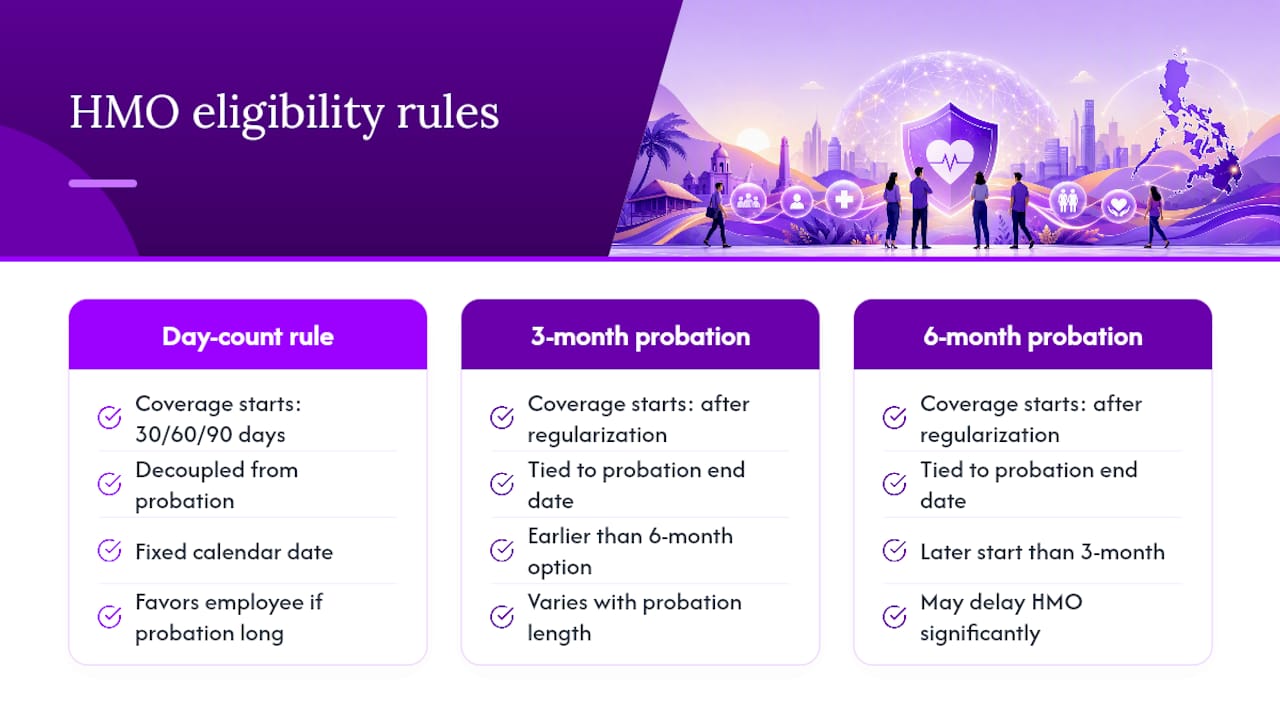
Probationary periods in the Philippines run up to six months by default, but actual practice varies. Some employers run shorter 90 day probation for rank and file roles, while others extend it closer to the statutory maximum for specialized positions.
That variation directly shapes HMO timing. An employer using a “coverage after regularization” rule with a three month probation gets employees onto HMO coverage far faster than one using the same rule with a six month probation. Employees evaluating a job offer should ask specifically how long probation runs and how that interacts with the HMO clause, since two companies can use identical eligibility language and produce very different real-world waiting periods.
Some employers instead peg HMO eligibility to a flat day count (30, 60, or 90 days) rather than to the regularization date itself. This approach decouples HMO timing from probation length entirely, which can work in the employee’s favor if the probation period runs long, or against them if it’s short. There’s no single standard here, which is exactly why the written clause matters more than any assumed industry norm. An employee relying on what a friend’s company does elsewhere is relying on the wrong document.
Typical Waiting Periods or Exclusions for Pre-Existing Conditions During Probation
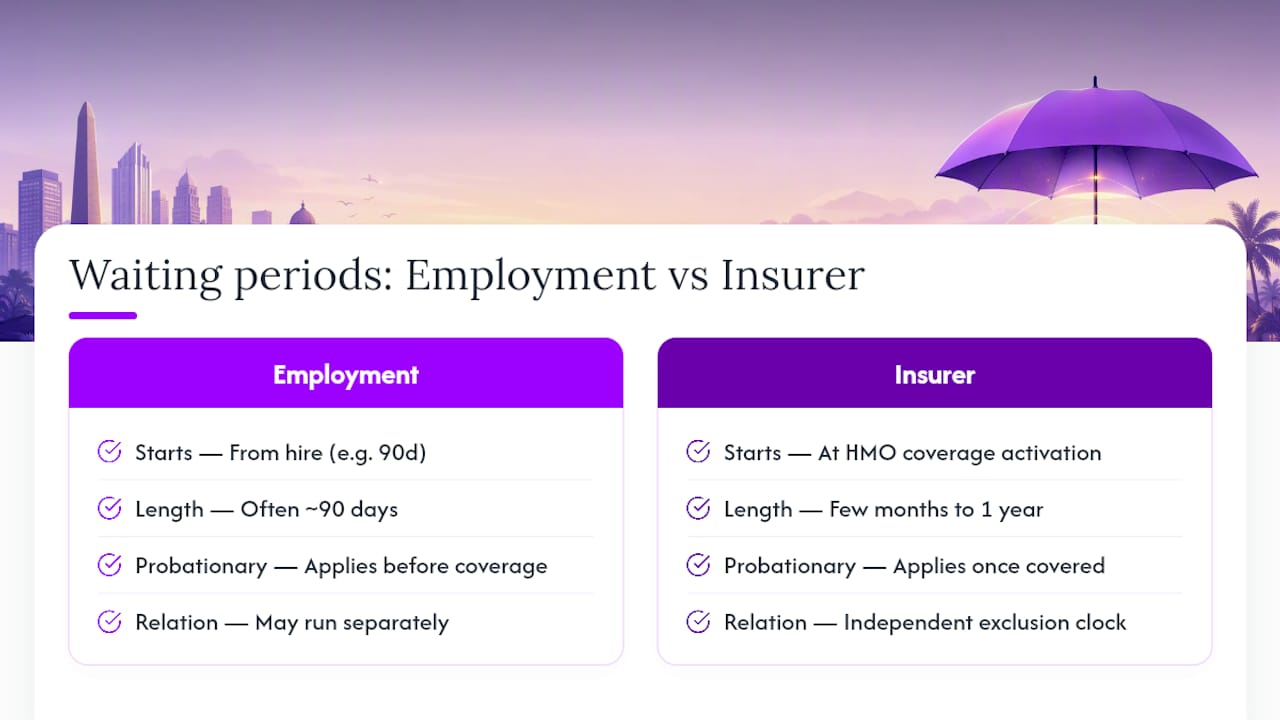
Waiting periods for pre-existing conditions are a standard feature of most Philippine HMO master policies, and they typically apply the same way to probationary and regular employees once coverage activates. Common exclusion windows run anywhere from a few months to a full policy year for conditions diagnosed before enrollment, though exact terms depend entirely on the specific insurer contract the employer signs.
This creates a layering effect worth understanding: an employee might face both an employment-side waiting period (say, 90 days before HMO coverage starts at all) and then an insurer-side exclusion period for any pre-existing condition once that coverage begins. The two clocks don’t necessarily run together, and HR rarely explains this distinction clearly during onboarding.
If a caveat about waiting periods applies to standard enrollees, the same caveat should apply consistently to probationary hires once their coverage activates. Employers who apply a stricter pre-existing condition exclusion to probationary employees than to regular staff, without a documented insurer-driven reason, risk the same non-diminution and equal-treatment scrutiny that applies to timing disputes generally. Employees should ask specifically whether their insurer’s exclusion terms differ by employment classification, since the master policy document, not the employee handbook, is the definitive source on this question.
Differences in HMO Coverage Levels or Benefit Restrictions for Probationary vs Regular Employees
Coverage tiers between probationary and regular employees usually differ in scope and timing rather than in the core benefit itself. Once a probationary employee is enrolled, the plan typically mirrors what regular employees get in terms of hospital network access, room and board, and outpatient benefits, since insurers generally price and administer a single group policy rather than running two parallel plans within the same company.
Where the real difference shows up is in what’s excluded before regularization: dependent coverage, higher room categories reserved for tenured staff, or optional add-ons like dental and annual physical exams that some employers reserve for confirmed regular employees. These restrictions are policy choices, not insurer requirements, which means they’re negotiable at the point an SME designs its benefits structure.
A practical test for whether a restriction is defensible: is it written down, applied the same way to every probationary hire in a comparable role, and tied to a real cost or risk reason? A restriction that meets that bar (say, no dependent coverage until regularization to control claims exposure during the highest-turnover period of employment) tends to hold up. A restriction applied inconsistently, where some probationary hires get full coverage and others don’t for no documented reason, is the kind of gap that turns into a company-practice claim down the line.
Case Studies or Examples Illustrating Disputes Over HMO Coverage for Probationary Staff
Disputes over HMO coverage for probationary staff typically surface in one of two patterns. In the first, an employee was verbally told during interviews that HMO coverage would start “right away,” but the actual offer letter and handbook were silent or contradicted that promise. When the employee is later denied coverage or dependent enrollment, the case turns entirely on which document controls, and written terms almost always win over recollected conversations.
In the second pattern, a company enrolled probationary employees in HMO coverage for an extended period as informal practice, then abruptly stopped for a new batch of hires without changing any written policy. Employees hired under the old, unwritten practice who lost expected coverage have a stronger non-diminution argument than employees hired after the practice changed, since the core legal question is whether a benefit already being received was withdrawn, not whether a new hire was promised something that never materialized.
Both patterns point to the same lesson: disputes rarely hinge on whether HMO coverage is legally required, since it isn’t. They hinge on what was documented, what was consistently practiced, and how clearly the employer communicated the actual rule before the employee accepted the job.
Practical Advice for Probationary Employees: What Documents and Questions to Request
Before you sign anything, ask HR for the exact HMO eligibility clause in writing, whether as part of your offer letter or a handbook excerpt. Request the insurer’s certificate of coverage once enrolled, since it confirms your actual effective date and dependent eligibility, not just what a recruiter mentioned. Ask directly: when does my HMO start, are dependents covered and when, and has my PhilHealth registration been filed?
Keep copies of every email or message discussing these terms. If a promised benefit is withheld without explanation, raise it with HR in writing first; if unresolved, DOLE or a labor lawyer can assess whether Article 100 or a documented company practice applies to your case.
Give Your Team the HMO Coverage Timeline They Can Actually Count On
Some HMO providers offer staged-eligibility options suitable for SMEs, letting employers set enrollment timing, dependent eligibility, and coverage tiers aligned with their probationary policies instead of conforming to rigid insurer contracts.
Some features address these problems: flexible enrollment windows allow aligning HMO start dates with probation length instead of a fixed insurer calendar; optional dependent add-ons permit enrolling the employee at hire and adding family coverage after regularization without renegotiation; and cashless access across a nationwide network helps ensure consistent coverage for probationary hires and long-term employees alike.
If you’re drafting or revising your HMO eligibility policy this year, explore Hmoplans’ plan features or get in touch for a quote tailored to your headcount and renewal timeline.
— Eumir
Sources
- Mandatory Benefits for Probationary Employees
- Employer Obligations on HMO and Health Insurance Benefits Promised to Employees in the Philippines
- Entitlement to HMO dependent benefits after regularization (Philippines)
- Employee hospital bill rights — probationary Philippines
FAQ
Do Probationary Employees Get HMO in the Philippines?
Not automatically. HMO is a voluntary benefit, so probationary employees get it only if their employer’s contract, handbook, or established practice provides it, unlike PhilHealth, SSS, and Pag-IBIG, which apply from Day 1 regardless of status.
What Benefits Are Probationary Employees Entitled to in the Philippines?
Probationary employees are entitled to the same statutory benefits as regular employees, including PhilHealth, SSS, and Pag-IBIG coverage, plus any HMO or other benefit their employer has promised in writing or granted as consistent practice.
Is There an HMO for Government Employees?
Government employees in the Philippines are primarily covered through PhilHealth and agency-specific benefit programs rather than a private HMO market; private HMOs like the plans Hmoplans offers are typically purchased by private employers, particularly SMEs, for their workforce.
What Is the Cheapest HMO in the Philippines?
Pricing varies widely by insurer, benefit limits, and group size, so there’s no single cheapest plan across the market; SMEs comparing costs should request quotes based on headcount and desired coverage tiers, since per-employee HMO pricing depends heavily on those factors.
Do Employees Pay for HMO?
It depends on the employer’s policy. Many Philippine SMEs cover the full HMO premium as an employee benefit, while others split the cost or charge employees for dependent add-ons, and this arrangement is typically spelled out in the offer letter or handbook.
