

HMO Room Categories Guide for Philippine HR Teams
TL;DR:
- Understanding HMO room classifications is crucial for controlling costs and ensuring employee satisfaction in Philippine plans. Private, semi-private, and ward rooms determine premiums, benefits, and accommodation experience, shaped by regulatory standards and hospital classifications. Tailoring room categories to workforce segments and reviewing benefits regularly enables effective plan optimization and reduces employee out-of-pocket expenses.
If you are an HR manager or business owner in the Philippines trying to build a solid employee benefits package, this HMO room categories guide is where you need to start. Most companies sign up for HMO coverage without realizing that room classification sits at the center of every major coverage decision: how much you pay in premiums, what your employees experience during a hospital stay, and whether your plan actually delivers value. Understanding HMO room types is not a nice-to-have skill. It is the difference between a health plan that works and one that frustrates everyone involved.
Table of Contents
- Key Takeaways
- HMO room categories guide: what each type means
- Regulatory and underwriting standards for room classification
- Using room category knowledge to optimize your plan
- My take on why room categories are undervalued
- Find the right plan for your team at Hmoplans
- FAQ
Key Takeaways
| Point | Details |
|---|---|
| Room category drives cost | The room type chosen directly affects your premiums, co-payments, and overall plan cost. |
| Three main categories exist | Philippine HMO plans generally classify rooms as private, semi-private, or ward/shared. |
| Compliance shapes classification | Regulatory and underwriting standards determine how insurers define and price each room category. |
| Customization prevents waste | Tailoring room categories to your workforce demographics avoids both under-coverage and overspending. |
| Communication gaps are costly | Unclear room category communication between HR and employees leads to benefit dissatisfaction and avoidable claim disputes. |
HMO room categories guide: what each type means
Philippine HMO plans use room classification as the foundational structure for determining inpatient benefit tiers. The category assigned to an employee’s plan tells the hospital what level of accommodation the insurer will cover, and it tells the employee what to expect when they check in. Getting this wrong at the plan selection stage creates problems that are hard to fix mid-coverage year.
There are three primary categories you will encounter when reviewing HMO plans:
- Private room: A single-occupancy room with a dedicated bathroom, often with amenities such as a television and additional seating for family members. This is the premium tier and carries the highest room and board benefit. Employees admitted at this level experience less noise, more privacy, and faster nursing response.
- Semi-private room: A shared room with one other patient, typically with a shared or separate bathroom depending on the facility. This is the most common mid-tier option offered by SME HMO plans. It balances comfort with cost.
- Ward or shared room: A multi-bed room accommodating three or more patients. This is the most basic category and carries the lowest room and board allowance. It is often used as the entry-level tier for plans with tighter budgets.
The table below breaks down how these HMO room types compare across the factors that matter most to HR managers:
| Category | Occupancy | Room and Board Benefit | Typical Premium Impact | Best Suited For |
|---|---|---|---|---|
| Private | 1 person | Highest | Higher premium | Senior staff, executives |
| Semi-private | 2 persons | Mid-range | Moderate premium | Most rank-and-file employees |
| Ward/Shared | 3 or more | Lowest | Lower premium | Budget-conscious plans |
Room category directly influences insurance premiums and co-pay requirements in Philippine HMO plans. This means choosing a private room category for all employees when most of your workforce is entry-level is a fast way to overspend. Conversely, assigning ward-level coverage to mid-level staff who expect better can become a retention issue. The right answer sits in the data about your actual workforce.
Pro Tip: Ask your HMO provider to show you the exact room and board peso limit per category before signing. Knowing whether “private room” means ₱3,000 or ₱5,000 per day changes the math on your plan selection entirely.
Regulatory and underwriting standards for room classification
Room categories in Philippine HMO plans do not come from arbitrary decisions. They are shaped by underwriting guidelines, accreditation standards, and how hospitals classify their own facilities. When an HMO provider assigns a room category to a plan, they are working within a framework of minimum standards that affects which rooms qualify for coverage and at what rate.
Philippine HMOs operate under the oversight of the Insurance Commission and the Department of Health, both of which set standards for accredited facilities. These standards influence how hospital rooms are categorized by HMO underwriters. A room that meets the minimum size, ventilation, and safety requirements qualifies for coverage under the relevant category. One that falls short may trigger a downgrade in coverage or require the patient to pay the difference out of pocket.

For context on how room standards function globally, minimum sleeping room sizes such as 6.51 square meters for one person and 10.22 square meters for two persons set baseline expectations that regulators use when classifying accommodation levels. While Philippine standards differ from international benchmarks, the principle is the same: physical room specifications feed directly into classification, which feeds directly into coverage.
Here is what HR managers need to watch for when reviewing HMO room requirements:
- Whether the hospitals in your plan’s accredited network classify their rooms the same way your provider does. A mismatch creates out-of-pocket exposure for employees.
- Whether your provider’s room category definitions align with the actual hospital rates in your area. A private room benefit of ₱2,500 per day is meaningless in Metro Manila where private room rates often start at ₱4,500.
- Whether compliance with room standards is verified annually. Local regulatory standards often impose higher minimums than national baselines, so verify exact classifications with your provider each renewal cycle.
Pro Tip: Request a list of your plan’s accredited hospitals along with the room and board rates for each category. Compare them against what the plan actually covers. That gap is your employees’ out-of-pocket exposure.
Using room category knowledge to optimize your plan
This is where the HMO room categories guide moves from theory to practice. Once you understand what each category means and how it is priced, you can make decisions that genuinely serve your workforce without burning through your benefits budget.
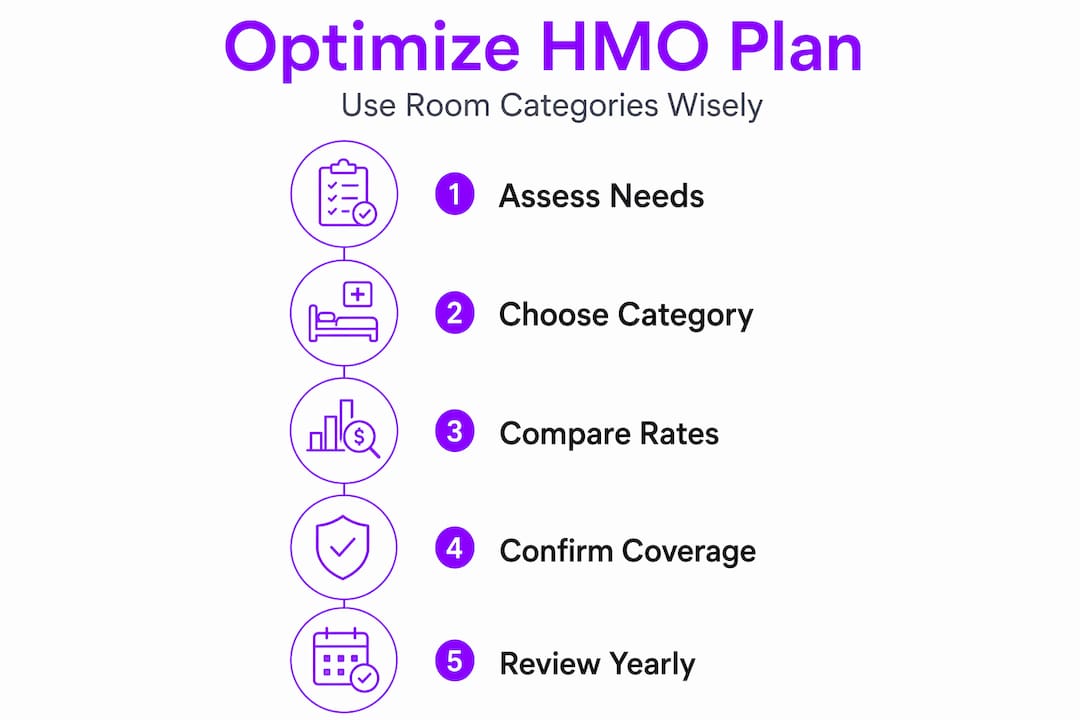
Tailoring coverage to workforce needs prevents under-coverage and controls costs. The goal is not to give everyone the cheapest option or the most expensive one. It is to match the right category to the right employee segment based on actual usage patterns and workforce demographics.
Start by segmenting your workforce. Executives and senior managers typically expect private room coverage as part of a competitive package. Mid-level employees are often satisfied with semi-private, especially if the plan is paired with strong outpatient benefits. Rank-and-file employees enrolled in entry-level plans may not prioritize room category at all compared to outpatient access and dependents’ coverage.
Once you have your segments defined, factor in these practical considerations:
- Premium impact: Private rooms usually cost more but offer stronger benefits. Running the numbers on a tiered room category structure, where different employee levels receive different room categories, often produces significant annual savings compared to blanket private room coverage.
- Co-payment triggers: Many HMO plans allow employees to upgrade their room during a hospital stay, but the difference between their covered category and the actual room rate becomes a co-payment. Make this crystal clear during onboarding or you will field angry calls from employees who thought they had full coverage.
- Emergency care buffer: Emergency care coverage often applies regardless of room classification, but the specific details vary by plan. Knowing this distinction helps you explain benefits accurately to employees and prevents the misperception that a lower room category means worse emergency coverage.
- Out-of-network exposure: Even with strong in-network coverage, employees admitted to non-accredited facilities may find their room category benefit does not apply. Build this into your employee education materials.
Common pitfalls when selecting room categories
Understanding the theory is one thing. Avoiding the mistakes that most HR teams make is another. These are the errors that cost businesses money and damage employee trust.
- Assuming one category fits all. Assigning the same room category to every employee regardless of role or tenure is the most common mistake. It either over-spends on junior staff or under-delivers for senior ones. A tiered approach almost always performs better.
- Confusing room category with plan quality. A ward-level room category does not automatically mean worse medical care. The clinical treatment is the same. The difference is comfort and privacy. Many employees do not realize this, and HR teams often fail to communicate it clearly.
- Ignoring the room rate gap. The benefit amount attached to a room category and the actual market rate for that room type in your local hospitals are often not the same number. When benefit amounts trail market rates, employees absorb the difference. This is a plan design flaw, not a claims error.
- Skipping annual reviews. Hospital room rates increase. Minimum room standards get updated. An HMO plan that was well-calibrated two years ago may now leave employees underinsured at the same room category. Review your plan’s room benefit amounts every renewal cycle.
- Not verifying provider-specific room classifications. Premium tenants and employees alike value amenities beyond just room size. Make sure your plan’s private room definition actually includes what your employees expect, not just the physical space.
My take on why room categories are undervalued
I have seen a lot of HMO renewals go sideways, and the root cause is almost always the same. Business owners and HR teams treat room category as a line item to be minimized rather than a strategic variable to be understood.
In my experience, the companies that get the most out of their HMO plans are not the ones spending the most. They are the ones who asked the right questions before signing. They knew what their employees would actually need during a hospital stay, they understood the gap between covered benefit amounts and real room rates, and they built their plan structure around that information.
What I find most interesting is that balancing cost with employee satisfaction requires more nuance than simple price comparisons. I have watched HR managers choose the cheapest room category across the board to hit a budget number, only to spend months fielding employee complaints and processing out-of-pocket reimbursement requests that wiped out the savings they thought they made.
The smarter approach is to treat room category knowledge as a real competency. Know what each tier covers. Know the hospital rates in your accredited network. Know what your workforce segments actually expect. When you do that, you stop reacting to plan problems and start designing plans that work from day one.
— Eumir
Find the right plan for your team at Hmoplans

If this guide has shown you anything, it is that choosing the right HMO room category is not guesswork. It requires a plan built around your actual workforce. Hmoplans, powered by Purple Cow, gives Philippine SMEs exactly that: tiered room category options designed to match real employee needs without the inflated price tag of enterprise plans.
Every Hmoplans coverage includes cashless access to accredited hospitals, 24/7 nationwide coverage, and room and board benefits calibrated to each category. What makes it different is the 100% coverage commitment for pre-existing conditions and the flexibility to customize by employee level. You can assign private room coverage to your senior team and semi-private to your general workforce, all within one plan structure.
Explore your SME plan options at Hmoplans and see which room category configuration fits your team best.
FAQ
What are the main HMO room categories in the Philippines?
Philippine HMO plans typically classify inpatient rooms into three categories: private, semi-private, and ward or shared rooms. Each category carries a different room and board benefit amount and corresponds to a different premium level.
Does room category affect the quality of medical treatment?
No. Room category affects accommodation comfort and privacy, not the standard of clinical care. Employees in ward-level rooms receive the same medical treatment as those in private rooms at accredited hospitals.
How does room category affect my company’s HMO premiums?
Room category directly influences premiums and co-pay requirements. Private room categories carry higher premiums, while semi-private and ward categories reduce monthly costs. Tiering categories by employee level is a practical way to control total plan costs.
Can employees upgrade their room during a hospital stay?
Most HMO plans allow room upgrades, but the employee pays the difference between the covered room rate and the actual rate of the upgraded room. This co-payment can be significant, so employees should be informed of this before they need to use their benefits.
Is emergency care affected by room category selection?
Emergency care coverage generally applies regardless of room category, though specific details vary by plan. HR managers should confirm emergency care terms with their HMO provider to avoid confusion during actual medical emergencies.
