

Step by step SME insurance guide for Philippine businesses
TL;DR:
- Most Philippine SMEs struggle with health insurance due to confusion between mandatory PhilHealth and private HMO plans. Proper preparation, accurate data, and timely online remittance through the EPRS system are crucial for compliance and coverage continuity. Tailoring HMO plans to employee needs enhances satisfaction and retention while ensuring regulatory adherence.
Getting health insurance right for your employees is one of the most consequential administrative tasks an SME owner faces in the Philippines, and most businesses get it wrong not from negligence but from sheer confusion. The step by step SME insurance process spans two distinct tracks: mandatory PhilHealth enrollment and private HMO coverage, each with its own forms, portals, deadlines, and penalties. Miss a single step and you risk rejected payments, gaps in employee coverage, and regulatory exposure. This guide walks you through both tracks clearly, so you can protect your team and stay compliant without losing weeks to bureaucratic back-and-forth.
Table of Contents
- Understanding SME health insurance in the Philippines
- Preparing for PhilHealth employer registration and employee enrollment
- Step-by-step online registration and remittance for PhilHealth contributions
- Selecting and enrolling your SME in a private HMO health insurance plan
- Common challenges and compliance tips for SME insurance management
- The overlooked importance of modular, aligned insurance solutions for SMEs
- Explore tailored HMO plans designed for Philippine SMEs
- Frequently asked questions
Key Takeaways
| Point | Details |
|---|---|
| Understand coverage types | SME health insurance includes both mandatory PhilHealth enrollment and optional private HMO plans with broader benefits. |
| Prepare documents early | Gather and complete all required employer and employee forms and business permits before PhilHealth registration. |
| Follow remittance rules | Generate SPA monthly and remit payments on time according to PEN deadlines to avoid penalties. |
| Customize HMO plans | Choose modular health insurance packages tailored to your employees’ needs to balance costs and benefits. |
| Maintain compliance controls | Implement internal processes to ensure accurate employee data, timely remittance, and reconciliation each month. |
Understanding SME health insurance in the Philippines
Before you touch a single form, you need to understand what you are actually buying and why it matters. Philippine law requires every employer to enroll their employees in PhilHealth, the government’s social health insurance program. PhilHealth covers a defined set of hospital and surgical benefits, but its benefit packages have ceilings that often leave employees with significant out-of-pocket expenses for even routine care.
This is exactly where private HMOs (Health Maintenance Organizations) fill the gap. A corporate HMO plan gives your employees access to outpatient consultations, laboratory tests, and confinement benefits that PhilHealth does not fully absorb. As part of understanding SME insurance in the Philippines, it helps to know that group health coverage typically includes doctor consultations, laboratory tests, hospital confinement, emergency care, and preventive healthcare within group health insurance plans for SMEs.
Here is a quick breakdown of what each layer covers:
- PhilHealth: Mandatory government coverage, inpatient-focused, benefit packages have fixed ceilings
- HMO primary care: Outpatient consultations, diagnostics, and pharmacy benefits
- HMO hospitalization: Room and board, specialist referrals, surgical coverage beyond PhilHealth
- HMO emergency care: 24/7 access, nationwide network, cashless transactions at accredited facilities
- Preventive services: Annual physical exams, vaccinations, and wellness programs (often add-ons)
The most important thing to internalize early is that PhilHealth and an HMO are not interchangeable. They are layered. You need both, and they serve different functions. Review the key differences between PhilHealth and HMO coverage before you decide on a private plan, because the gaps you identify there will drive your HMO negotiations.
Now that you understand the types of health insurance relevant to SMEs, let’s review the preparation steps needed before enrollment.
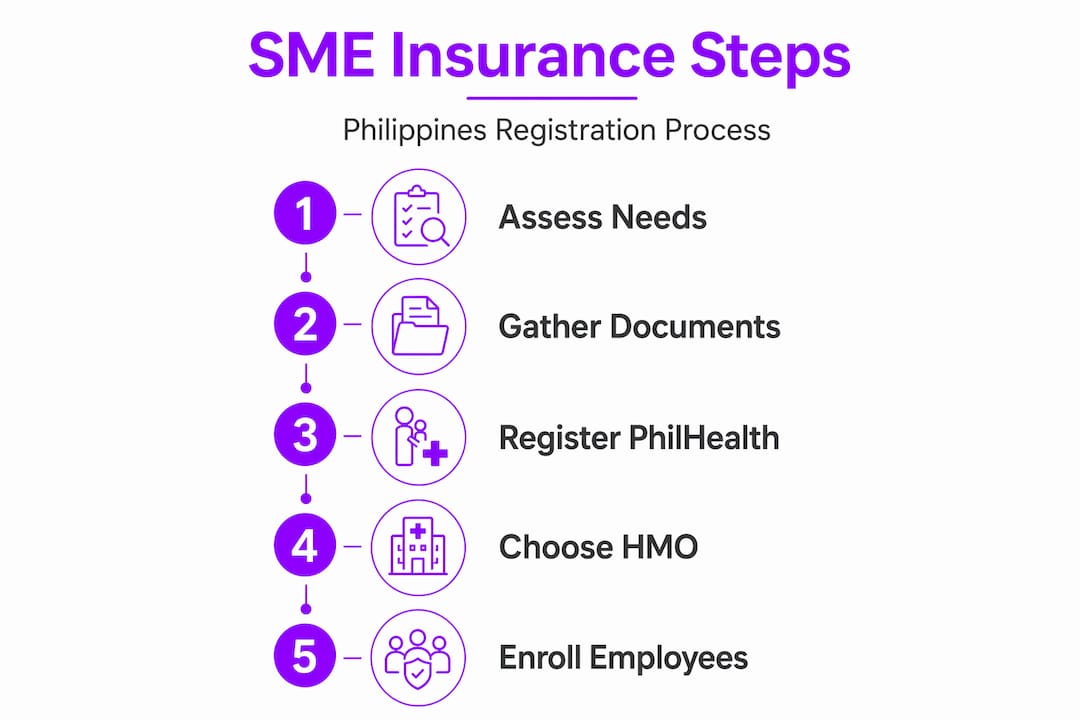
Preparing for PhilHealth employer registration and employee enrollment
The most common reason SMEs stall during registration is showing up without the right documents. PhilHealth has a strict checklist, and a missing paper means a wasted trip or a delayed Employer Number.
Employer registration requirements include the business permit, SEC or DTI registration, a valid ID from the authorized signatory, and two critical forms:
| Form | Purpose | Who fills it out |
|---|---|---|
| ER1 | Employer Data Record, captures company info | Employer/HR |
| ER2 | Employee Data Records, lists all covered employees | Employer/HR |
| PMRF | PhilHealth Member Registration Form, for employees not yet registered | Employee |
Documents you must prepare before visiting your local PhilHealth office or accessing the online portal:
- Business permit from your local government unit
- SEC Certificate of Registration (for corporations) or DTI Certificate (for sole proprietors)
- Valid government-issued ID of the authorized employer representative
- Completed ER1 and ER2 forms downloaded from the official PhilHealth website
- List of employees with their PhilHealth Identification Numbers (PINs) where available
Accuracy matters more than speed here. A single transposed digit in an employee’s PIN or a mismatched name will create contribution mismatches later that are tedious to fix. The SME health coverage guide recommends verifying all employee data against government IDs before submission. Once processed, you receive your PhilHealth Employer Number (PEN), which drives every subsequent remittance deadline you will ever have.
For new employees who have never registered with PhilHealth, they complete the PMRF independently, and you attach copies to your submission. Reviewing the full SME enrollment process in detail before your first submission will save you at least one return visit.
With preparation complete, you can now proceed to the actual registration and enrollment steps for both PhilHealth and private insurance options.
Step-by-step online registration and remittance for PhilHealth contributions
Once you have your PEN, all premium remittance moves through the Electronic Premium Remittance System (EPRS), PhilHealth’s online employer portal. The process is more structured than most people expect, and the key rule that trips up even experienced HR teams is the “No SPA, No Payment” policy, which requires employers to generate a Statement of Premium Account before any payment can be processed.
Here is the step-by-step remittance process:
- Log in to EPRS using your PEN at the official PhilHealth employer portal.
- Verify employee records. Confirm that all active employees are listed and their PhilHealth Identification Numbers are accurate.
- Update employment changes. Add new hires, deactivate separated employees, and reflect any salary changes that affect contribution brackets.
- Generate the SPA. The SPA is your monthly payment reference. It calculates total premiums based on current employee salaries and the contribution rate.
- Note the SPA reference number. This number is required by your bank or digital payment channel.
- Pay through accredited channels. These include PhilHealth’s partner banks, over-the-counter bank payments, and digital channels like GCash.
- Download and file your payment confirmation. Keep digital and physical copies for audit purposes.
| PEN ending digit | Payment deadline |
|---|---|
| 1 to 5 | 11th to 15th of the following month |
| 6 to 0 | 16th to 20th of the following month |
Pro Tip: Schedule SPA generation at least three business days before your PEN deadline. EPRS can experience slowdowns near cutoffs, and a late SPA means a late payment, which triggers interest charges regardless of intent.
For SMEs streamlining employee health benefits, integrating your payroll system with a reminder calendar for SPA generation is one of the simplest operational upgrades you can make. It costs nothing and eliminates the most common source of PhilHealth penalties.
After registering and remitting PhilHealth contributions, let’s also explore the private HMO insurance enrollment process common for SMEs.
Selecting and enrolling your SME in a private HMO health insurance plan
Choosing an HMO is not a checkbox exercise. The right plan depends on who your employees actually are, not on a generic sales brochure. Start by mapping your workforce: average age, common health complaints reported through sick leaves, and whether most employees are based in Metro Manila or spread across provincial locations.

Modular HMO packages allow SMEs to negotiate which services are included based on employee common health needs, which means you are not locked into buying a plan loaded with benefits your team will never use.
Key steps for HMO enrollment:
- Assess your workforce. Collect anonymized data on average age, dependents, and reported health concerns. A tech startup with employees in their mid-twenties has very different needs from a hospitality company with staff across three generations.
- Request proposals from providers. Ask for itemized breakdowns of what each benefit tier includes, not just the headline premium. The gap between providers often lives in the fine print around pre-existing conditions and specialist access.
- Negotiate modular coverage. Push for dental, annual physical exams, and maternity riders if your demographics warrant them. Drop services with low utilization probability to reduce costs.
- Confirm network access. For SMEs with employees outside Metro Manila, verify that the HMO’s accredited network includes hospitals in your employees’ home provinces.
- Enroll employees with complete data. Submit employee names, dates of birth, and dependent information accurately. Errors here delay card issuance and can cause cashless claim rejections.
- Communicate the plan. Send each employee a one-page summary of what is covered, which hospitals are in-network, and how to use their card. Unused benefits are a waste of your premium spend.
Pro Tip: Coordinate your HMO’s benefit year with your PhilHealth remittance calendar from the start. When an employee is hospitalized, knowing exactly which charges go to PhilHealth first and which the HMO absorbs reduces claim disputes significantly.
The HMO support framework for SMEs in 2026 has expanded to include digital access portals and telemedicine services, which are worth prioritizing for distributed teams.
With both PhilHealth and HMO enrollment covered, let’s review important tips and how to avoid common compliance pitfalls.
Common challenges and compliance tips for SME insurance management
Most SME insurance problems are not complicated. They are predictable, and they are preventable. The same mistakes appear across businesses of all sizes.
“Treat SPA generation as mandatory before any payment to avoid failed remittances; build internal controls to ensure monthly compliance.” — GreatDay HR
The biggest recurring issues and how to fix them:
- Late or missed SPA generation. This is the single most common cause of rejected PhilHealth payments. Build a recurring monthly task in your project management tool or HR system three to five days before your PEN deadline.
- Inaccurate employee data. Names, birthdates, and PINs that do not match PhilHealth’s records cause misposted contributions. Audit your employee list every quarter, especially after onboarding or separations.
- Failure to deactivate separated employees. You keep paying contributions for people who no longer work for you. Run a payroll-to-insurance cross-check every payroll cycle.
- No digital payment trail. Using cash or checks without digital confirmation makes auditing painful. Shift to bank transfers or GCash with automatic receipt generation.
- Ignoring HMO utilization reports. Most HMO providers give quarterly utilization data. Review it. If a specific benefit is being used heavily, that is a signal to increase the limit at renewal. If something is never used, drop it.
Maintaining an HMO eligibility checklist for new hires and a corresponding offboarding protocol for departing employees will close the two biggest compliance gaps most SMEs face.
The overlooked importance of modular, aligned insurance solutions for SMEs
Here is something the standard SME insurance guide will not tell you: getting PhilHealth compliant is the floor, not the goal.
Too many Philippine SMEs treat HMO coverage as an afterthought, something added after PhilHealth compliance is sorted. The result is a plan that technically exists but does not actually fit the people it is supposed to serve. A 30-person tech company buys the same generic HMO package a 200-person manufacturing firm uses. Nobody wins. The employees feel the coverage is inadequate. The employer wonders why premiums feel expensive for the value received.
HMO plans must match employee health profiles to deliver maximum value, and that means proactive design, not passive purchasing. Look at your sick leave data before your next renewal. If respiratory conditions appear frequently, that tells you something about your work environment and your coverage priorities. If mental health days are rising, ask whether your current plan includes any behavioral health access.
There is also a retention argument that rarely gets made explicitly: employees who feel their health needs are covered stay longer. The cost of replacing one mid-level employee in the Philippines ranges from one to two months of salary when you factor in recruitment, onboarding, and lost productivity. A well-designed HMO plan that costs a few hundred pesos per employee per month pays for itself if it contributes to even marginally lower turnover.
The SMEs that get this right treat their insurance portfolio as a living document, reviewing it annually against actual employee demographics and utilization data, not just renewing the same package because it is familiar.
Explore tailored HMO plans designed for Philippine SMEs
Running through this entire process, from PhilHealth registration to HMO enrollment, takes time. The part that should not take time is finding a private health plan that actually fits your team.
HMO Plans, in partnership with Purple Cow and Etiqa, offers flexible group health insurance built specifically for Philippine SMEs. You get 100% coverage for pre-existing conditions, access to the Big 9 Hospitals and Healthway Clinics, cashless nationwide care, and modular add-ons like dental, annual physicals, and life insurance that you can build based on your workforce’s actual needs. There are no unnecessarily complicated terms. For hands-on guidance through enrollment and ongoing claims support, the HMO member services team is available to walk your HR team through every step.
Frequently asked questions
How do I register my SME as a PhilHealth employer?
Submit ER1 and ER2 forms along with your business permit, SEC or DTI registration, and a valid ID at your nearest PhilHealth office or through the online portal to receive your PhilHealth Employer Number (PEN).
What is the “No SPA, No Payment” policy in PhilHealth remittances?
This policy requires employers to generate a Statement of Premium Account in the EPRS before remitting contributions. Without a valid SPA reference number, payment channels will not process the transaction.
Can SMEs customize their HMO coverage?
Yes. Modular HMO packages allow SMEs to include or exclude specific services based on employee health profiles and budget, so you pay for what your team actually needs rather than a fixed bundle.
What health services does SME group insurance typically cover?
Group HMO coverage for SMEs commonly includes doctor consultations, laboratory tests, hospital confinement, emergency care, and preventive healthcare services like annual physical exams.
How can SMEs avoid penalties on PhilHealth contributions?
Generate your SPA at least three days before your PEN-based deadline, maintain accurate employee records, and reconcile payroll with remittance reports every month to catch discrepancies before they become compliance issues.
