

HR Guide to Out-of-Network Reimbursement in the Philippines
TL;DR:
- Managing out-of-network reimbursements effectively requires understanding key terms like UCR, coinsurance, and balance billing to prevent costly surprises.
- Preparation involves verifying coverage, obtaining detailed superbills, ensuring accurate provider information, securing pre-authorization, and coordinating billing codes before claim submission.
When an employee gets treated outside your HMO’s accredited network, the bill does not just disappear. It lands on your desk, usually with incomplete documentation and a deadline. For HR professionals and business owners in the Philippines, this guide to out-of-network reimbursement is about converting that stressful moment into a manageable process. Out-of-network claims involve more variables than in-network ones, and without a clear system, you end up with denied claims, unhappy employees, and administrative headaches that pile up fast.
Table of Contents
- Key takeaways
- Understanding out-of-network reimbursement
- Preparation steps before filing a claim
- How to submit and track out-of-network claims
- Troubleshooting denied or delayed claims
- Strategies to reduce OON costs for Philippine SMEs
- What I have learned after watching businesses struggle with this
- How Hmoplans makes reimbursement simpler for SMEs
- FAQ
Key takeaways
| Point | Details |
|---|---|
| Know the terminology first | Understanding terms like UCR, coinsurance, and balance billing prevents costly surprises in reimbursement outcomes. |
| Prepare before submitting | Collecting the right documents, including superbills and pre-authorization approvals, before submission dramatically reduces denials. |
| Follow a structured process | Using the correct claim forms and submission method, with accurate billing codes, speeds up reimbursement timelines. |
| Appeal denials systematically | Most denied claims can be overturned with a well-documented appeal filed promptly after the denial notice. |
| Educate employees proactively | Employees who understand their out-of-network benefits make better care decisions and generate cleaner claims. |
Understanding out-of-network reimbursement
Before you can manage out-of-network insurance claims well, your team needs to understand what they are and why they behave differently from standard HMO claims.
Out-of-network reimbursement refers to the process where an insurer pays back an employee or employer for medical expenses incurred at a provider or facility not contracted with the health plan. Unlike in-network care where the provider bills the insurer directly, out-of-network care typically requires the employee to pay upfront and then submit a claim to receive partial repayment.
Here is the core terminology you need to know:
- Deductible: The amount an employee must pay out of pocket before insurance kicks in. OON deductibles are separate and often higher than in-network deductibles, meaning employees may wait longer before reimbursements start.
- Coinsurance: The percentage of costs shared between the insurer and employee after the deductible is met. A typical split might be 70/30 or 60/40 in favor of the insurer.
- UCR (Usual, Customary, and Reasonable) rates: The benchmark amount an insurer considers acceptable for a specific service in a given area. Anything above this rate is typically not covered.
- Balance billing: When a provider charges their full fee and the insurer only reimburses the UCR amount, the gap is billed to the patient. Providers charge full chargemaster rates while insurers reimburse only their allowed amount, shifting that cost difference directly to employees and, indirectly, to businesses.
- Allowable amount: The maximum an insurer will pay for a specific service, regardless of what the provider charges.
In the Philippine context, most corporate HMO plans operate through accredited provider networks, and out-of-network coverage is often an optional benefit. Out-of-network care can cost two to five times more than in-network equivalents, which makes understanding these terms not just academic but directly relevant to your company’s finances.
Pro Tip: Review your HMO plan’s schedule of benefits specifically for the OON section. Many Philippine SMEs discover too late that their plan has a separate OON deductible that resets independently from their in-network deductible.
Preparation steps before filing a claim
Submitting a reimbursement claim without proper preparation is the single biggest cause of denials. Here is a step-by-step process to get it right before anything is submitted.
-
Verify coverage details. Pull up the employee’s Certificate of Coverage or Member Handbook and confirm that out-of-network benefits are included. Note the specific deductible amount, coinsurance percentage, and any annual maximum for OON claims.
-
Advise the employee to request a superbill. A superbill is not just a receipt. A valid superbill must include the provider’s NPI number, ICD-10 diagnosis codes, CPT procedure codes, date of service, and proof of payment. A simple receipt or statement will almost always be rejected.
-
Confirm correct provider information. The provider’s name, license number, Tax Identification Number (TIN), and clinic address must match what is on the claim form exactly. A single mismatch can trigger a denial.
-
Secure pre-authorization when required. For elective procedures, specialist referrals, or major treatments, pre-authorization reduces claim denials by validating medical necessity before the service is rendered. Get this in writing, not just verbally.
-
Coordinate with the service provider on billing codes. Errors in CPT or ICD-10 codes are a top reason claims are denied. Ask the provider’s billing staff to double-check codes against the procedure performed before issuing the superbill.
Pro Tip: Create a one-page OON claim preparation checklist for employees to bring to their appointment. Include what documents to request, questions to ask the provider’s front desk, and your HR contact information for follow-up. This alone cuts rework time significantly.
How to submit and track out-of-network claims
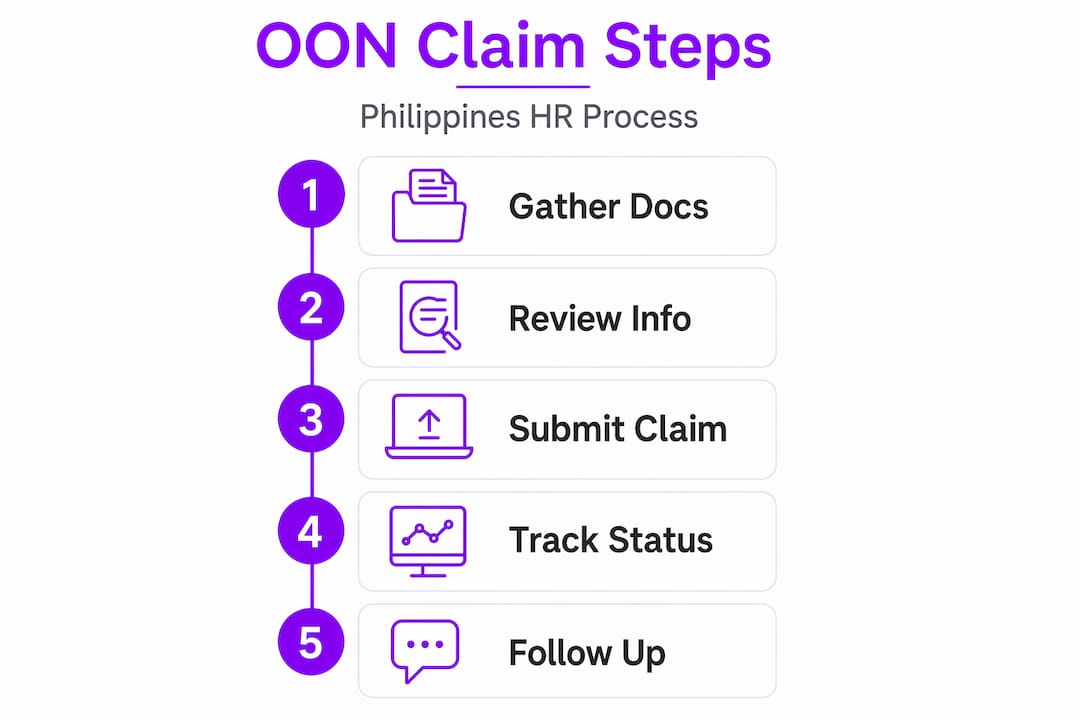
With your documents in order, the submission process becomes far less risky. The method you use and the accuracy of your forms are what separate fast approvals from prolonged delays.
Most HMO providers in the Philippines have a designated reimbursement form. In addition, if your plan mirrors international standards, you may need to complete something equivalent to a CMS-1500 form. Within that form structure, specific fields matter a great deal for signaling out-of-network status and ensuring payment is directed correctly.
Here is what a complete OON claim submission package should contain:
- Completed HMO reimbursement claim form
- Original or certified true copy of the superbill with all required codes
- Official receipts or proof of payment from the provider
- Pre-authorization approval letter (if applicable)
- Copy of the employee’s HMO member ID and Certificate of Coverage
- Any referral letters or physician orders relevant to the service
Submission method comparison:
| Method | Pros | Cons | Best for |
|---|---|---|---|
| Online portal | Faster, trackable, timestamped | Requires document scanning | Most standard claims |
| Email submission | Convenient, creates paper trail | May require follow-up | Smaller insurers or simple claims |
| Physical submission | Accepted universally | Slower, harder to track | Complex or disputed claims |
| Courier with acknowledgment | Creates proof of receipt | Additional cost and effort | High-value or sensitive claims |
Once submitted, track your claim actively. Request a reference number and note the insurer’s standard processing time in writing. Tracking claim repricing by third parties is critical to prevent revenue leakage, whether you are managing one claim or dozens across your employee roster. Set a calendar reminder to follow up if you have not received a response within 15 business days.
For HR teams managing multiple employee claims at once, a simple shared spreadsheet tracking claim reference numbers, submission dates, expected response deadlines, and current statuses saves hours of back-and-forth communication each month.

Troubleshooting denied or delayed claims
Even well-prepared claims get denied. 22% of insurers fail to pay dispute resolution determinations on time, and 35% of payments are delayed beyond required timeframes. The Philippine market has its own version of these delays, and knowing how to respond is what separates businesses that recover their costs from those that absorb them.
Here is a structured approach to resolving claim issues:
-
Read the denial letter carefully. Insurers are required to state the specific reason for denial. Common reasons include incorrect billing codes, missing documentation, lack of pre-authorization, or services deemed not medically necessary.
-
Gather supporting documentation for your appeal. This includes the original claim, the denial letter, any pre-authorization approvals, clinical notes from the treating physician, and a letter of medical necessity if not already included.
-
File the appeal within the insurer’s deadline. Most plans give you 30 to 60 days from the denial date. Missing this window closes your options significantly.
-
Escalate if the first appeal fails. Most insurers have a second-level internal appeal process. After exhausting internal options, you may file a complaint with the Insurance Commission of the Philippines or, for HMOs, the Department of Health.
Managing employee expectations during a claim dispute is as important as the appeal itself. Keep affected employees updated at each step, even if the update is simply that you are still waiting. Employees who feel informed remain patient; those left in silence assume the worst.
For recurring denial patterns, do not treat each case in isolation. If the same billing code keeps getting rejected, or the same provider’s superbills keep missing information, address the root cause rather than fixing individual claims one by one.
Strategies to reduce OON costs for Philippine SMEs
Managing the costs tied to out-of-network care is an ongoing effort, not a one-time fix. The businesses that do it well share a few common habits.
- Educate employees during onboarding and annual benefit reviews. Most employees do not know they have a separate OON deductible until they are already facing a large bill. Walk through real scenarios with numbers so the cost implications register clearly.
- Encourage in-network care first. When an employee’s preferred specialist is out of network, work with your HMO to identify whether a comparable provider exists within the accredited list. Many employees default to OON providers out of habit, not genuine necessity.
- Negotiate single-case agreements when warranted. For ongoing specialist care that is only available out of network, your HMO may agree to treat a specific provider as in-network for a defined period. This is more common than most HR managers realize.
- Implement a central claims tracking system. Whether you use a spreadsheet or dedicated HR software, centralizing claim records reduces lost documents and surfaces patterns in denials that training can fix. You can find useful documentation frameworks in resources like this health insurance checklist for BPOs.
- Review your HMO plan’s OON benefit structure annually. The benefits of out-of-network reimbursement include flexibility and continuity of care, but only if your plan’s structure actually supports efficient reimbursement. An annual review tells you whether your current plan still serves your workforce’s actual care patterns.
Out-of-network care, while often viewed primarily through the lens of cost, also offers privacy and personalized treatment that in-network arrangements may not. For employees managing sensitive health conditions, this matters. Businesses that acknowledge this reality, rather than simply discouraging all OON care, build more trust with their teams.
What I have learned after watching businesses struggle with this
From my experience working alongside HR teams and business owners across different Philippine industries, the most expensive mistake I see repeatedly is reactive management. Companies wait for a denial to arrive before figuring out what went wrong.
The businesses that navigate out-of-network reimbursements with the least friction are the ones that treated it as a system problem rather than a case-by-case problem. They built a checklist, trained a point person in HR, and established a clear protocol before the first complicated claim ever came through.
I will also say this plainly: the Philippine insurance market has specific friction points that generic guides ignore. Local HMOs often have less transparent UCR rate schedules than international counterparts, which makes it harder for employees to anticipate their actual out-of-pocket exposure. That opacity is not accidental. Insurers increasingly restrict out-of-network access under the framing of employer protection, but the actual effect is often preserving insurer margins at the expense of access.
My honest advice: do not just manage claims. Advocate for plan terms that give your employees real, usable out-of-network benefits. Read what you are buying, and push back on vague benefit language during renewal negotiations. The employee-facing reimbursement guide from Hmoplans is a good resource to share directly with your workforce so they understand what they are entitled to and how to protect it.
— Eumir
How Hmoplans makes reimbursement simpler for SMEs
If you have worked through this out-of-network reimbursement guide and realized your current HMO plan creates more problems than it solves, Hmoplans offers a better starting point. Built specifically for Philippine SMEs, Purple Cow’s HMO plans include genuine out-of-network reimbursement coverage with clear terms, no ambiguous exclusions, and member services built to support both HR administrators and employees through the claims process.
From the HMO plan features that cover pre-existing conditions at 100% up to the Maximum Benefit Limit, to the member services support team that assists with reimbursement inquiries, Hmoplans is designed so HR does not have to figure everything out alone. Explore what a plan built for your workforce actually looks like.
FAQ
What is out-of-network reimbursement?
Out-of-network reimbursement is the process where a health insurer repays an employee for medical expenses incurred at a provider not contracted with the health plan. The employee typically pays upfront, then submits a claim with required documentation to receive partial payment based on the plan’s allowable amounts.
What documents are needed to file an out-of-network claim?
A valid claim generally requires a superbill with ICD-10 and CPT codes, official receipts, a completed reimbursement form, and a copy of the employee’s HMO membership details. Pre-authorization approval letters should also be included when applicable.
Why do out-of-network claims get denied?
Common reasons include missing or incorrect billing codes, lack of pre-authorization, incomplete documentation, and services deemed not medically necessary. Reviewing the specific denial reason and filing a prompt appeal with supporting clinical documentation resolves most cases.
How long does out-of-network reimbursement take in the Philippines?
Processing times vary by insurer but typically range from 15 to 45 business days after submission. Incomplete claims and missing documents are the most common reasons for delays beyond that window.
Can employers negotiate better out-of-network terms with their HMO?
Yes. During plan renewal, employers can negotiate single-case agreements for specific high-use providers, request clearer UCR rate schedules, and push for higher OON reimbursement percentages, especially if the workforce has demonstrated OON usage patterns that justify it.
