

Insurance Exclusions: What Every Policyholder Must Know
An insurance exclusion is a specific provision in your policy that removes coverage for a named loss, event, or circumstance. When an exclusion applies, the insurer owes you nothing for that claim — not a reduced payout, but zero. Understanding insurance exclusions is the single most important skill for any policyholder, because a gap you don’t know about is a gap you can’t fix.
Your first two moves when you receive any policy:
- Find the policy form. Locate the full contract, not just the declarations page summary.
- Read the Exclusions section and the Definitions section. Both shape what is and isn’t covered, often more than the insuring agreement itself.
Key Takeaways
Policy exclusions determine whether a claim is payable at all — limits and deductibles only matter after coverage is confirmed.
| Point | Details |
|---|---|
| Exclusion vs. limitation | An exclusion means no payout; a limitation reduces the payout but doesn’t eliminate it. |
| Read Definitions first | Narrow definitions can function as hidden exclusions even when the Exclusions section is silent. |
| Contra proferentem protects you | Ambiguous exclusion language is typically interpreted against the insurer under U.S. law. |
| Endorsements close most gaps | A sewer backup endorsement costs $50–$150/year and covers claims far exceeding that amount. |
| Hmoplans addresses pre-existing gaps | Hmoplans offers 100% coverage for pre-existing conditions up to the Maximum Benefit Limit, removing one of the most common HMO exclusion risks for SMEs. |
Table of Contents
- What insurance exclusions actually are — and how they differ from limitations
- Common exclusions by policy type across major U.S. insurance lines
- Where to find exclusion language in your policy
- How U.S. law protects you when exclusion language is unclear
- How to close coverage gaps left by exclusions
- What to do when your claim is denied because of an exclusion
- Your policy review checklist and questions to ask your agent
- An honest perspective on what exclusions really mean for you
- Hmoplans covers what most HMO plans exclude
- Sources
What insurance exclusions actually are — and how they differ from limitations
An exclusion eliminates coverage entirely for a specific loss. A limitation (sometimes called a sub-limit) reduces how much the insurer pays but doesn’t cut coverage to zero. A condition is an obligation you must meet — like filing a claim within a set time — for coverage to apply at all. Confusing these three can cost you a claim.
According to Covera’s policy guide, policyholders routinely mistake limitations for exclusions and vice versa. If your homeowners policy pays a maximum of $2,500 for jewelry theft, that’s a limitation. If it refuses to pay anything for flood damage, that’s an exclusion.
Exclusions live in more places than most people expect. The dedicated Exclusions section is the obvious spot, but IRMI notes that critical limiting language is often embedded in Definitions and endorsements. A policy that defines “occurrence” narrowly to exclude gradual processes can defeat a claim even when the Exclusions section says nothing about it.
Why do insurers use exclusions at all? Three reasons:
- Risk management. Catastrophic, correlated events like floods, earthquakes, and war could bankrupt a carrier if bundled into standard policies. Carving them out keeps the insurer solvent for everyday losses.
- Affordability. Removing uninsurable or high-frequency risks from the base policy keeps premiums lower for everyone.
- Insurability boundaries. Some losses — intentional acts, for example — are simply not insurable by design.
Pro Tip: Read the Definitions section before the Exclusions section. A narrow definition of a key term can function as a hidden exclusion, and you won’t catch it unless you read both.
Common exclusions by policy type across major U.S. insurance lines
Every major policy type carries its own standard exclusions. Here’s what to watch for in each.
Homeowners
- Flood. FloodSmart (FEMA) confirms that flood damage is excluded from standard homeowners policies. You need a separate National Flood Insurance Program (NFIP) or private flood policy.
- Earthquake. Excluded in most standard forms; requires a separate policy or endorsement.
- Sewer backup. Typically excluded unless you add a specific endorsement.
- Wear and tear / gradual deterioration. The Insurance Information Institute (III) notes this is a standard exclusion — sudden damage may be covered, but long-term decay is not.
- Vacancy. Policies often restrict or void coverage when a home sits vacant beyond a state-specified period, commonly around 60 days.
Auto
- Transportation for hire. The NAIC confirms that personal auto policies exclude rideshare and delivery driving unless a commercial endorsement is added. An accident while working for a rideshare platform can void coverage entirely under a personal policy.
- Excluded drivers. Named individuals can be specifically excluded from coverage by endorsement.
- Racing and intentional acts. No standard personal auto policy covers damage from racing or deliberate collisions.
- Wear and tear. Mechanical breakdown from normal use is not a covered peril.
Health and HMO
- Pre-existing conditions. Many plans restrict or delay coverage for conditions diagnosed before enrollment, though the Affordable Care Act limits this for most individual and group plans. HMO-specific language varies — check how pre-existing conditions are handled in your specific plan.
- Cosmetic and experimental procedures. Elective cosmetic surgery and treatments not yet approved as standard of care are routinely excluded.
- Out-of-network care. HMO plans typically exclude non-emergency care outside the provider network.
- “Not medically necessary.” Insurers can deny claims by classifying a treatment as not medically necessary, even when a physician recommends it.
Life
- Suicide clause. Most life policies exclude suicide deaths during the first one to two years of the policy — the contestability window. The NAIC documents this as a standard industry practice.
- Non-disclosure of material facts. Misrepresenting health history on the application can void the policy during the contestability period.
- Hazardous activities. Skydiving, scuba diving, and similar activities may be excluded or require an additional premium.
Business (Commercial)
- Pollution and environmental liability. Standard commercial general liability (CGL) policies exclude most pollution claims; a separate environmental policy is needed.
- Professional services. A CGL policy does not cover errors in professional advice — that requires professional liability (E&O) coverage.
- Business property on personal policies. Home-based business equipment is often excluded or sub-limited under a personal homeowners policy.
- Business-use exclusions. Courts look for repeated, profit-motivated activity when determining whether a “business pursuit” exclusion applies, per ReadMyPolicy.ai.
Travel
- Pre-existing medical conditions. Most travel policies exclude medical claims tied to conditions diagnosed before the trip unless a waiver is purchased.
- Travel warnings. Trips to destinations under a U.S. State Department travel warning are commonly excluded.
- High-risk activities. Adventure sports like bungee jumping or mountaineering are often excluded from standard travel medical coverage.
| Policy Type | Key Exclusion | Common Fix |
|---|---|---|
| Homeowners | Flood damage | Separate NFIP or private flood policy |
| Homeowners | Sewer backup | Sewer backup endorsement |
| Auto | Rideshare/delivery use | Rideshare endorsement or commercial policy |
| Health/HMO | Out-of-network care | Select in-network providers; check plan rules |
| Life | Suicide (contestability window) | Wait out the contestability period |
| Business | Professional liability | Separate E&O policy |
| Travel | Pre-existing conditions | Pre-existing condition waiver at purchase |
Where to find exclusion language in your policy
Most policyholders read the declarations page and stop there. That page is a summary — it tells you what you bought, not what’s excluded. The real contract lives in the policy form, and exclusions are scattered across six distinct sections.
- Declarations page. Lists covered property, limits, and named insureds. Rarely states exclusions directly.
- Insuring agreement. Describes what the insurer promises to cover — read this to understand the baseline promise before looking for carve-outs.
- Definitions section. Read this first. As IRMI advises, a narrow definition of “occurrence,” “property,” or “bodily injury” can function as an effective exclusion even when the Exclusions section is silent.
- Exclusions section. The primary list of what is not covered. Look for both absolute exclusions and exceptions to exclusions (coverage that is restored for specific circumstances).
- Conditions section. Contains obligations — notice requirements, cooperation clauses, proof of loss deadlines. Failing a condition can void an otherwise valid claim.
- Endorsements and riders. Pages attached to the base policy that add, remove, or modify coverage. An endorsement can both create and eliminate exclusions.
Watch for these trigger phrases in exclusion language:
That last clause — “regardless of other causes” — signals an anti-concurrent causation (ACC) clause. ACC clauses can deny an entire loss when an excluded peril and a covered peril combine to cause damage. A few states limit ACC through efficient proximate cause rules, so check your state’s law alongside the policy language, per LegalClarity.
How U.S. law protects you when exclusion language is unclear
Insurers draft policy language, and courts have long recognized the power imbalance that creates. Two legal doctrines and one regulatory mechanism give policyholders meaningful protection.
Contra proferentem: When exclusion language is genuinely ambiguous, U.S. courts typically interpret it against the drafter — meaning against the insurer and in favor of the policyholder.
The Legal Information Institute at Cornell Law School documents contra proferentem as a foundational contract doctrine. It doesn’t apply to clear language, but when a term has two reasonable meanings, the one that favors coverage usually wins in court.
Contestability in life insurance works differently. During the first one to two years of a life policy, the insurer can investigate and rescind the policy for material misrepresentation on the application. Suicide during this window is also commonly excluded. After the contestability period ends, the insurer’s ability to contest most claims narrows significantly, per NAIC guidance.
State Departments of Insurance (DOI) regulate policy language and handle consumer complaints. If an insurer denies a claim based on an exclusion you believe is being applied incorrectly:
- File a complaint with your state DOI. Most states have online portals and respond within 30 days.
- The DOI can compel the insurer to explain its position and, in some cases, reverse a denial.
- The National Association of Insurance Commissioners (NAIC) maintains a directory of all state DOI contacts at content.naic.org.
How to close coverage gaps left by exclusions
Finding an exclusion is step one. Deciding whether and how to fix it is step two. You have four main options.
Endorsements and riders attach to your existing policy and buy back a specific excluded coverage. A sewer backup endorsement, for example, typically costs $50–$150 per year and can cover claims that run into the tens of thousands of dollars. That’s one of the highest-value gap-fillers available to homeowners, according to ReadMyPolicy.ai.
Separate policies are necessary when the excluded risk is too large or too distinct to bundle. Flood insurance through the NFIP, earthquake policies, and standalone professional liability policies all fall here.
Commercial endorsements or policies solve business-use exclusions. If you drive for a rideshare platform, a rideshare endorsement on your personal auto policy fills the gap during the period between accepting a ride and dropping off the passenger — the window most personal policies leave uncovered.

Umbrella policies add a liability layer above your home and auto policies, but they follow the underlying policy’s exclusions. An umbrella won’t cover flood damage; it covers liability claims that exceed your primary policy’s limits.
| Fix | Best For | Relative Cost | Procurement Time |
|---|---|---|---|
| Endorsement/rider | Single excluded peril | Low | Days |
| Separate policy | Catastrophic or distinct risk | Moderate to high | Days to weeks |
| Commercial policy | Business-use or professional risk | Moderate | Days to weeks |
| Umbrella policy | Excess liability only | Low to moderate | Days |
Pro Tip: Match the fix to the financial risk, not the premium. A $100/year sewer backup endorsement is worth buying. A $500/year earthquake policy on a $600,000 home in a high-risk zone is also worth buying. The math is the guide.
Action checklist for closing gaps:
- List every exclusion that applies to a risk you actually face.
- Estimate the financial exposure if that loss occurred.
- Ask your agent whether an endorsement exists to buy it back.
- If no endorsement is available, price a separate policy.
- Get any coverage change confirmed in writing as an endorsement, not just a verbal assurance.
What to do when your claim is denied because of an exclusion
A denial letter citing an exclusion is not the end of the road. Follow this sequence.
- Request the denial in writing if you haven’t received it. The letter must cite the specific policy language the insurer is relying on.
- Pull the exact policy language. Read the cited exclusion alongside the Definitions section. Check whether an exception to the exclusion applies to your situation.
- Gather contemporaneous evidence. Photos taken immediately after a loss, receipts, maintenance records, and contractor reports all matter. The III notes that insurers sometimes invoke “wear and tear” on claims that were actually sudden and accidental — maintenance records showing regular upkeep directly counter that argument.
- Understand the burden of proof. When an insurer invokes an exclusion, the evidentiary burden often shifts to the insurer to prove the exclusion applies, per LegalClarity. That procedural asymmetry is useful in appeals.
- File an internal appeal. Most insurers have a formal appeal process. Submit your evidence and a written argument explaining why the exclusion does not apply.
- Escalate to your state DOI if the internal appeal fails and you believe the denial is improper.
- Hire a public adjuster for complex property claims. Public adjusters work for you, not the insurer, and can re-document a loss and negotiate on your behalf.
- Consult a coverage attorney when the claim is large, the exclusion language is ambiguous, or the insurer’s conduct suggests bad faith. Contra proferentem and bad-faith statutes give attorneys real leverage in these situations.
Key evidence types that weaken exclusion-based denials:
- Timestamped photos taken within hours of the loss
- Maintenance logs and service receipts showing the property was in good condition
- Independent contractor or engineer reports on the cause of loss
- Written communications with the insurer showing inconsistent positions
Your policy review checklist and questions to ask your agent
Use this checklist before your next renewal or agent call.
- [ ] Locate the full policy form (not just the declarations page).
- [ ] Read the Definitions section for narrow definitions of “occurrence,” “property,” “resident,” and “bodily injury.”
- [ ] Identify every named exclusion and mark the ones that apply to risks you actually face.
- [ ] Check for vacancy clauses if you own a rental or vacation property.
- [ ] Review all endorsements attached to the policy — some add coverage, some remove it.
- [ ] Confirm whether any business activities are covered or excluded under your personal policies.
- [ ] Check dependent coverage rules if family members are on your health or HMO plan.
Questions to ask your agent or insurer:
- “Is [specific risk] excluded under my current policy?”
- “Can I add an endorsement to cover it, and what is the annual cost?”
- “Is there a waiting period before the endorsement takes effect?”
- “Will adding this endorsement change my premium or deductible?”
- “If I make a claim, will this affect my renewal rate?”
- “Can you confirm that answer in writing or as a policy endorsement?”
Always get coverage changes documented as a signed endorsement. A verbal confirmation from an agent is not binding on the insurer.
An honest perspective on what exclusions really mean for you
Most people treat their insurance policy like a terms-of-service agreement: they accept it without reading it and assume it covers what they need. That assumption is where exclusions do their damage.
The gap between what a policy promises in its insuring agreement and what it actually pays after exclusions are applied can be enormous. A homeowner who assumes flood damage is covered because they have “full coverage” homeowners insurance will discover the truth only after a storm. A rideshare driver who doesn’t know their personal auto policy excludes transportation for hire may find themselves personally liable after an accident. An HMO member who doesn’t check the pre-existing condition language in their plan may face a denied claim at the worst possible moment.
My practical suggestion: pick two exclusions from your current policy that apply to risks you genuinely face, and ask your agent about them before your next renewal. For homeowners, flood and sewer backup are the two most commonly overlooked gaps. For drivers with side income, the business-use exclusion deserves immediate attention. For HMO buyers at SMEs, the pre-existing condition clause and out-of-network care rules are the first things to verify.
You don’t need to become a policy expert. You need to know which exclusions matter to your specific situation and whether a fix exists. That’s a 30-minute conversation with your agent — and it’s worth having before you need to file a claim.
Hmoplans covers what most HMO plans exclude
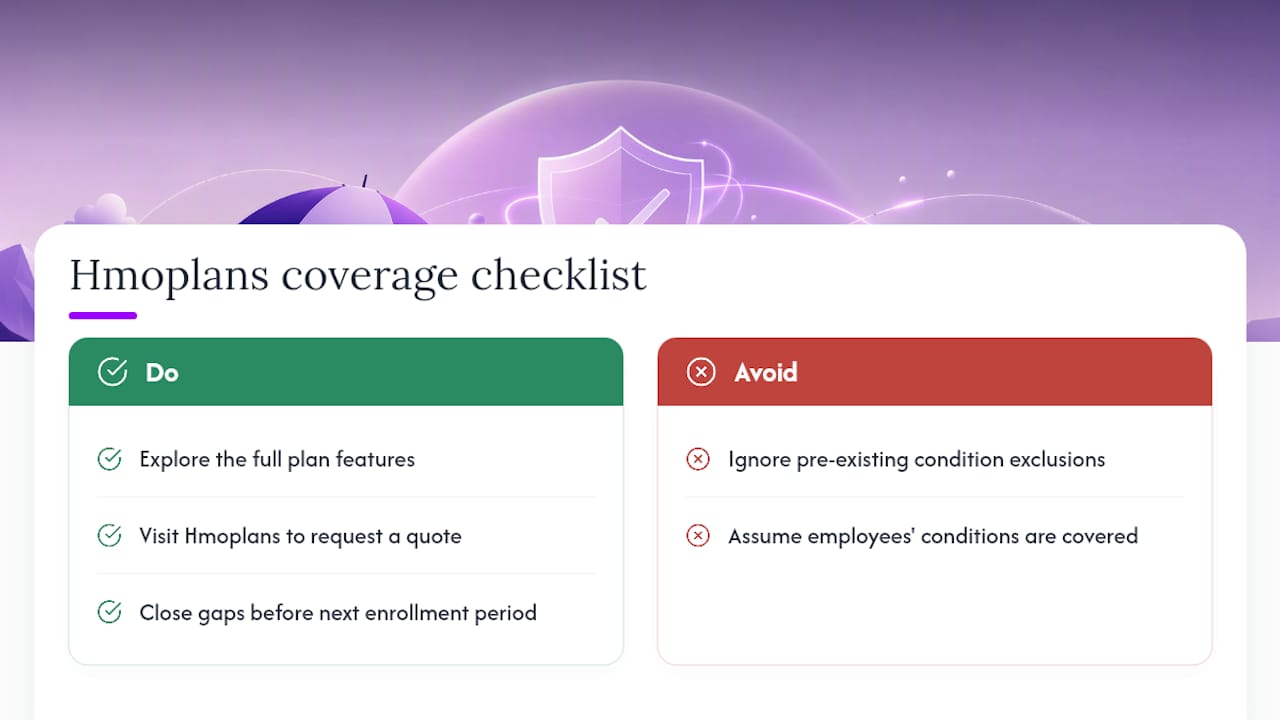
For SME owners and HR teams evaluating health coverage, the pre-existing condition exclusion is often the most consequential gap in a standard HMO plan.

That coverage extends to cashless access at accredited hospitals including the Big 9 Hospitals and Healthway Clinics, 24/7 nationwide care, and optional add-ons for dental, annual physical exams, and life and accident insurance. If your current plan excludes conditions your employees already have, that’s a gap worth closing before the next enrollment period. Explore the full plan features or visit Hmoplans to request a quote for your team.
This article is general information, not a substitute for advice from a qualified financial advisor. Consult a qualified financial professional about your own circumstances before acting on anything here.
Sources
These U.S. resources are the authoritative starting points for exclusion-related research, complaints, and coverage decisions.
- National Association of Insurance Commissioners (NAIC)
- Insurance Information Institute (III)
- Legal Information Institute — Cornell Law School
- FloodSmart (FEMA)
- International Risk Management Institute (IRMI)
Save your full policy documents — not just the declarations page — in a secure, accessible location. If a claim is denied, you’ll need the complete policy form to evaluate the insurer’s position.
