

Group Health Pooling Explained: What Employers Need to Know
Group health pooling is the practice of combining the medical claims and financial risk of many members into one shared fund so that premiums reflect the group’s average cost rather than any single person’s health history. According to the American Academy of Actuaries, pooling smooths claims volatility and stabilizes premiums across the group. Three things matter most:
- Premiums reflect the pool, not the individual. Your rate is set on the collective claims experience of everyone enrolled, which protects high-risk members and keeps coverage accessible.
- Pooling improves predictability, not necessarily absolute cost. Renewal swings shrink, but average premium levels still track the pool’s overall health status and claims mix.
- Who bears residual risk depends on the funding model. In a fully insured plan, the carrier absorbs excess claims. In a self-funded arrangement, the employer does, often with stop-loss protection.
The Commonwealth Fund confirms that broader pools and risk-adjustment mechanisms support affordability, yet pool composition remains the dominant driver of premium levels. Understanding risk pooling in health insurance is the first step toward making a smarter benefits decision for your team.
Key Takeaways
Group health pooling is a risk-management tool that stabilizes renewal premiums by spreading claims across a shared fund, not a guaranteed path to lower absolute costs.
| Point | Details |
|---|---|
| Core definition | Pooling combines members’ claims into one shared fund so premiums reflect group averages, not individual health history. |
| Predictability vs. cost | Pooling reduces renewal volatility; it does not automatically lower premiums if the pool’s health status is poor. |
| Pool composition matters | Age, claims history, and participation rate drive premiums more than pool size alone. |
| Funding model determines risk | Fully insured transfers claims risk to the carrier; self-funded retains it with the employer, requiring stop-loss protection. |
| Hmoplans for SMEs | Hmoplans offers fully insured group HMO plans with comprehensive coverage for pre-existing conditions, built for SME teams seeking stable, predictable benefits. |
Table of Contents
- How insurers build and price a risk pool
- What types of pooled arrangements exist in the U.S.?
- How adverse selection threatens a pool and how carriers prevent it
- How funding models change who actually bears the risk
- What pooling means specifically for small employers
- How ACA rules changed pooling in the individual market
- What actually drives premiums inside a pool
- How to evaluate pooled group coverage: a practical checklist
- A clearer way to think about what pooling actually delivers
- Hmoplans offers group coverage built for SME teams
- Sources
How insurers build and price a risk pool
When an insurer sets a group premium, it starts by estimating expected claims for the entire enrolled population, then layers on additional cost components. The result is a per-member-per-month rate that every enrolled employee pays, regardless of individual health status.
The four core components of a pooled premium are:
| Component | What it covers | Effect on rate |
|---|---|---|
| Expected claims | Projected medical costs for the group | Largest driver; tracks historical loss ratios |
| Administrative load | Underwriting, billing, and service costs | Spread across more members as pool grows |
| Profit and margin | Insurer’s required return | Relatively fixed percentage of premium |
| Stop-loss/reinsurance load | Cost of catastrophic-claim protection | Higher for smaller or sicker pools |
As described by GroupHEALTH Benefit Solutions, the insurer collects premiums from plan sponsors, pools those funds, and pays future claims from the pooled account so that losses are shared across all member sponsors. A company with 10 employees that experiences one catastrophic claim in a given year would face a brutal renewal without pooling. Inside a pool of 500 employees, that same claim is diluted across the larger base, and the renewal impact shrinks considerably.
Participation rates matter here. When too few eligible employees enroll, the pool skews toward those who most need coverage, which pushes projected claims higher. Investopedia notes that group plans typically require a minimum participation threshold, often around 70% of eligible employees, to keep the risk profile balanced and premiums stable.
What types of pooled arrangements exist in the U.S.?
Group health coverage in the United States is delivered through several distinct pooled structures. Each carries different cost dynamics, regulatory oversight, and practical trade-offs.
Single-employer group plans are the most common arrangement. One employer sponsors a plan for its own workforce, and the insurer pools all enrolled employees under a single master policy. The employer gets a degree of plan customization, and the insurer uses the group’s own claims history to set rates for larger groups.
Multiple Employer Welfare Arrangements (MEWAs) allow two or more employers to jointly establish a benefits plan. They can lower costs by spreading administrative expenses across a larger base, but they carry meaningful risk. The U.S. Department of Labor warns that self-funded MEWAs present insolvency risk to participating employers if the pool lacks sufficient reserves, and state protections differ significantly from those covering fully insured plans.
Association health plans let employers in the same industry or trade group purchase coverage together. The appeal is buying power. The caution is that association plans have faced regulatory scrutiny over whether they meet ERISA’s commonality-of-interest tests and state insurance requirements.
Multi-employer plans are collectively bargained arrangements common in union industries. They pool workers across many employers in the same trade and are governed by joint labor-management trustees.
Key trade-offs across all arrangements:
- Cost stability tends to improve as pool size grows, but customization options narrow.
- MEWAs and association plans add compliance complexity; employers should verify solvency protections and state oversight before joining.
- As Cornell Law School’s Wex explains, group insurance covers multiple people under one policy, and administrative costs spread across many lives, which is why group rates are generally lower than individual market rates.
How adverse selection threatens a pool and how carriers prevent it
Adverse selection happens when healthier people opt out of a plan while sicker people stay in, leaving the pool with a disproportionately high-cost membership. Left unchecked, it creates a cycle: premiums rise, more healthy members leave, premiums rise again.
Carriers and employers use several standard tactics to limit this risk:
- Participation thresholds. Requiring roughly 70% of eligible employees to enroll, per Investopedia, prevents a plan from becoming a refuge only for those who need it most.
- Waiting periods. New hires typically must wait 30–90 days before coverage begins, which discourages employees from joining solely because they have an upcoming procedure.
- Open enrollment windows. Restricting enrollment to specific periods prevents employees from joining only when they anticipate high claims.
- Minimum employer contribution. When employers pay a meaningful share of the premium, employees are more likely to enroll regardless of health status, which broadens the pool.
Pro Tip: Ask your broker for the group’s participation rate history alongside its claims history. A pool with consistently high participation is a stronger signal of renewal stability than a pool that simply had a low-claims year.
How funding models change who actually bears the risk
The funding model determines whether the insurer or the employer absorbs excess claims. This is one of the most consequential decisions a benefits buyer makes.
| Dimension | Fully insured | Self-funded | Level-funded |
|---|---|---|---|
| Who bears claims risk | Carrier | Employer | Employer (with stop-loss cap) |
| Regulatory oversight | State insurance law | ERISA (federal) | ERISA (federal) |
| Cost volatility | Low (fixed premium) | High (claims-driven) | Moderate |
| Plan customization | Limited | High | Moderate |
| Reserve requirements | None for employer | Yes, significant | Partial |
In a fully insured plan, the employer pays a fixed premium and the carrier assumes all claims risk. Predictability is high; customization is limited. The NC Department of Insurance notes that a master group policy is issued to the employer, with employees as certificate-holders, and that state guaranty associations provide a backstop if the insurer becomes insolvent.
Self-funded plans flip that arrangement. The employer pays claims directly from its own reserves and typically purchases stop-loss insurance to cap exposure at a defined threshold, either per individual (specific stop-loss) or for aggregate claims across the group. Stop-loss is not optional for most small and mid-size employers; without it, a single catastrophic claim can destabilize the entire benefits budget. Critically, self-funded plans are not covered by state guaranty associations, so the employer’s own financial health and the stop-loss carrier’s solvency both matter.
Level-funded plans sit between the two. The employer pays a fixed monthly amount, but that amount is structured to cover expected claims plus a stop-loss premium. If claims come in below projections, the employer may receive a partial refund. If claims exceed the stop-loss threshold, the stop-loss carrier pays the excess.
What pooling means specifically for small employers
For SMEs, pooling is primarily a stability tool. It gives smaller companies access to benefit designs and provider networks that would be financially out of reach on a standalone basis, and it smooths the renewal volatility that can make budgeting for benefits feel unpredictable.
The practical advantages for SMEs include:
- Access to broader provider networks negotiated by the insurer across the full pool.
- More predictable year-to-year premium changes compared to individual or very small group markets.
- Ability to offer comprehensive benefits that attract and retain talent, even without the claims volume of a large employer.
The trade-offs are real, too. SMEs in pooled arrangements have less leverage to customize plan design. They may cross-subsidize other employers in the pool if their workforce is healthier than average. And joining a MEWA or association plan without verifying solvency protections can expose the company to liability for unpaid claims if the pool runs short.
Before joining any multi-employer pool, SME owners should confirm:
- The pool’s regulatory status (fully insured vs. self-funded) and which state or federal rules apply.
- Whether the arrangement is covered by a state guaranty association.
- The pool’s historical claims trends and reserve adequacy.
For a broader look at why group health insurance benefits SMEs, the case rests heavily on this stability argument.
How ACA rules changed pooling in the individual market
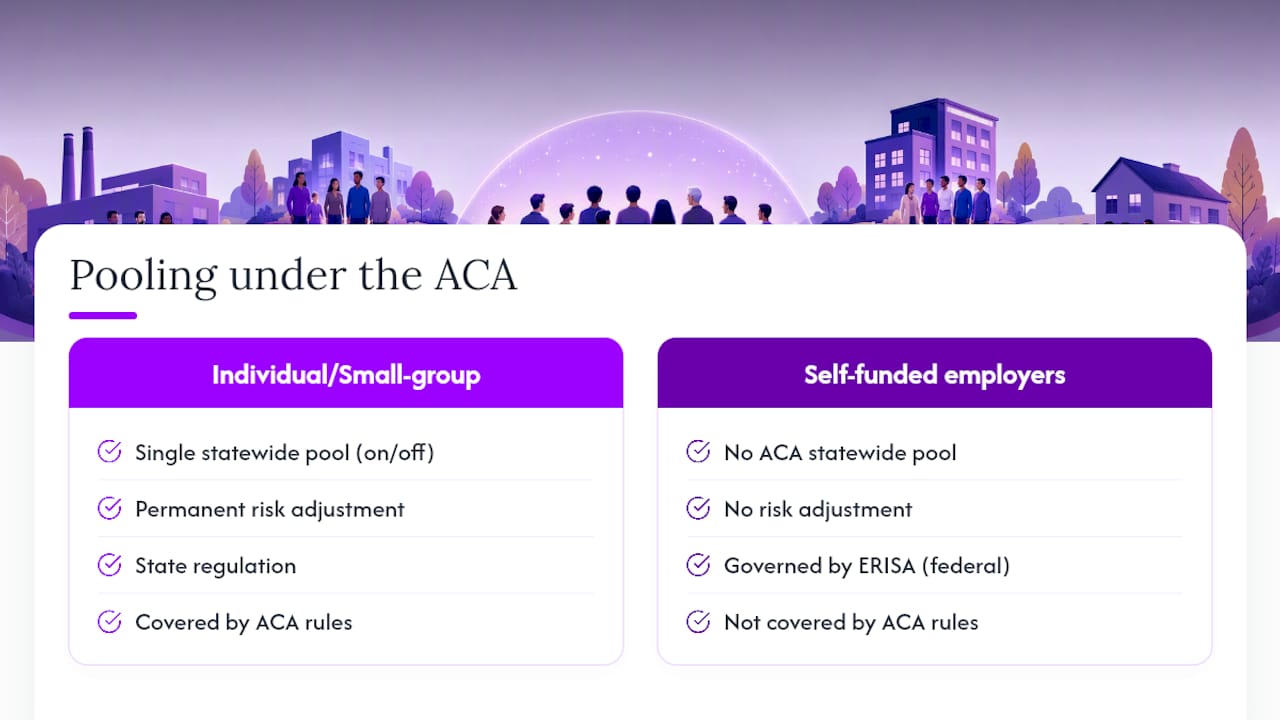
The Affordable Care Act drew a sharp line between individual-market pooling and employer-group pooling. In the individual market, the ACA requires insurers to maintain a single risk pool for all enrollees within a state, whether they buy on or off the marketplace. This prevents insurers from segmenting healthier buyers into cheaper pools and sicker buyers into more expensive ones.
To support that single-pool requirement, the ACA created a permanent risk adjustment program. Risk adjustment transfers payments among insurers based on the relative health risk of their enrollees. An insurer that attracts a sicker-than-average population receives payments from insurers with healthier-than-average populations, which reduces the financial incentive to avoid high-risk members.
The employer-group market operates under different rules. Large employer plans are primarily governed by ERISA at the federal level, while fully insured small-group plans face state insurance regulation. The ACA’s single-pool mandate and risk adjustment apply to the individual and small-group markets, not to self-funded employer plans.
Recent federal rulemaking continues to shape these dynamics. The CMS 2025 Marketplace Integrity and Affordability Final Rule addresses insurer pricing behavior and marketplace integrity in ways that affect how costs shift across individual-market pools. Separately, Brookings’ analysis of silver loading illustrates how insurer pricing decisions within the marketplace can redistribute costs across the pool in ways that are not always visible to enrollees.
What actually drives premiums inside a pool
Pool size matters, but it is not the primary lever. The American Academy of Actuaries is clear that aggregate health status and claims mix are the dominant drivers of average premium levels. A large pool with a high-cost membership will still carry high premiums.
The main factors that push premiums up or down:
| Driver | Direction of effect | Notes |
|---|---|---|
| Historical claims experience | Up if high, down if low | Most heavily weighted in renewal pricing |
| Age and demographics | Up with older workforce | ACA limits age rating to 3:1 in small-group market |
| Benefit design | Up with richer benefits | Raising deductibles lowers expected claims and premium |
| Geographic and network costs | Varies by region | Narrow networks typically reduce cost |
| Stop-loss/reinsurance pricing | Up when catastrophic risk is higher | Smaller pools pay more for this layer |
| Administrative load | Down as pool grows | Fixed costs spread across more members |
Benefit design is one lever employers actually control. A group that moves from a $500 deductible plan to a $1,500 deductible plan reduces the insurer’s expected claims payout, which flows through to a lower premium. The trade-off is higher out-of-pocket exposure for employees, so the savings need to be weighed against workforce impact.
How to evaluate pooled group coverage: a practical checklist
When assessing a pooled group plan, work through these steps before signing:
- Verify participation requirements. Confirm the minimum enrollment threshold and ask what happens to your rate if participation drops below it mid-year.
- Request pooled claims trend data. Ask the carrier or administrator for three years of aggregate claims trends for the pool, not just your own group’s history.
- Understand stop-loss terms. For self-funded or level-funded plans, get the specific and aggregate stop-loss attachment points in writing and confirm the stop-loss carrier’s financial rating.
- Confirm regulatory oversight. Ask whether the plan is fully insured (state-regulated) or self-funded (ERISA), and whether it is covered by a state guaranty association.
- Check solvency protections for MEWAs. If joining a multi-employer arrangement, request audited financials and reserve adequacy documentation before committing.
- Assess reporting access. Confirm you will receive regular claims reports and that you can see utilization data to manage costs proactively.
- Evaluate customization limits. Understand which plan design elements you can adjust and which are fixed by the pool’s master policy.
- Ask about renewal methodology. Find out whether renewals are based on your group’s own experience, the pool’s aggregate experience, or a blend of both.
Red flags to watch for: a carrier that cannot provide pooled claims trend data, a MEWA with no audited reserve statement, or a level-funded arrangement where the stop-loss carrier is unrated.
Pro Tip: Match your funding model to your cash-reserve posture. If your company cannot absorb three months of elevated claims without disrupting operations, a fully insured plan is the safer starting point, even if a self-funded arrangement looks cheaper on paper. For more on maximizing healthcare coverage for your employees, the plan design choices you make at enrollment have the longest-lasting cost impact.
A clearer way to think about what pooling actually delivers
The most common mistake benefits buyers make is treating pooling as a cost-reduction strategy. It is not. Pooling is a risk-management strategy. The distinction matters because it changes what you should be optimizing for.
If you enter a pooled arrangement expecting lower absolute premiums, you may be disappointed, especially if your workforce is younger and healthier than the pool average. You are, in effect, subsidizing higher-risk members in exchange for the protection of not being priced out of coverage yourself in a bad claims year. That trade is worth making for most SMEs, because the alternative, a standalone plan priced entirely on your own group’s experience, can produce catastrophic renewal increases after a single serious illness or injury.
Where pooling genuinely delivers is in renewal predictability. A well-managed pool with broad participation and sound stop-loss protection will produce far more stable year-to-year pricing than a standalone arrangement of the same size. That stability has real budget value, even when the absolute premium is not the lowest available.
For MEWAs and association plans specifically, the governance question is as important as the price. A pool that is well-priced today but inadequately reserved is a liability, not an asset. Before joining any multi-employer arrangement, get the audited financials and consult a benefits attorney or actuary. The DOL’s MEWA guidance exists precisely because these arrangements have a documented history of insolvency when governance fails.
Hmoplans offers group coverage built for SME teams
If you are an SME owner or HR decision-maker who has just worked through the mechanics of group health pooling, the next practical question is where to find a plan that delivers the stability and coverage breadth this article describes, without the compliance complexity of a MEWA or the cash-reserve demands of a self-funded arrangement.
Hmoplans, powered by Purple Cow and underwritten by Etiqa, provides fully structured group HMO plans designed specifically for SMEs. Optional add-ons include dental, annual physical exams, and life and accident insurance, so you can tailor the plan to your team without building a benefits program from scratch. Explore the full plan features and get a quote from an HMO expert today.
Sources
The following primary sources support the analysis in this article and are worth consulting for original documents or deeper explanation.
- American Academy of Actuaries
- Group Health Insurance | NC DOI
- Health Insurance Risk Pooling Is Key to Maintaining Affordability | Commonwealth Fund
- CMS fact sheet: 2025 marketplace integrity and affordability final rule
- Understanding marketplace silver loading | Brookings
