

Why Reimbursable Health Insurance Works for Philippine SMEs
TL;DR:
- Reimbursable health insurance allows employees to seek care anywhere and receive reimbursements after paying upfront.
- It provides greater hospital choice, especially for remote or traveling workers, but requires careful management of documentation and cash flow.
Reimbursable health insurance is a plan where employees pay their medical bills upfront and then submit claims to recover those costs from their insurer. Unlike cashless plans that settle directly with accredited hospitals at discharge, reimbursement plans give employees the freedom to seek care anywhere, then get paid back. For business owners and HR managers in the Philippines, understanding why reimbursable health insurance fits certain workforce needs can shape smarter benefit decisions. The tradeoff is real: more hospital choice in exchange for more paperwork and a temporary cash outlay.
Why reimbursable health insurance matters for Philippine SMEs
Reimbursable health insurance, also called a reimbursement plan, is the industry term for coverage where the insured pays first and the insurer repays later. Cashless plans work the opposite way: the insurer settles directly with the hospital, and the employee walks out without paying a bill. Both models fall under standard HMO or health insurance frameworks, but they serve different workforce realities.

Philippine SMEs often operate across multiple cities and provinces. A cashless plan tied to a narrow hospital network can leave an employee in Cebu or Davao with no covered facility nearby. Reimbursement plans solve that gap by allowing access to any hospital, regardless of network status. That flexibility is not a minor perk. For businesses with field teams, remote workers, or employees who travel frequently, it is a functional necessity.
Employers also gain more control over benefit design. Reimbursement plans support cost control by letting employers define what they reimburse, set spending limits, and tailor coverage to their actual workforce. That level of customization is harder to achieve with fixed cashless products.
How does reimbursable health insurance work in practice?
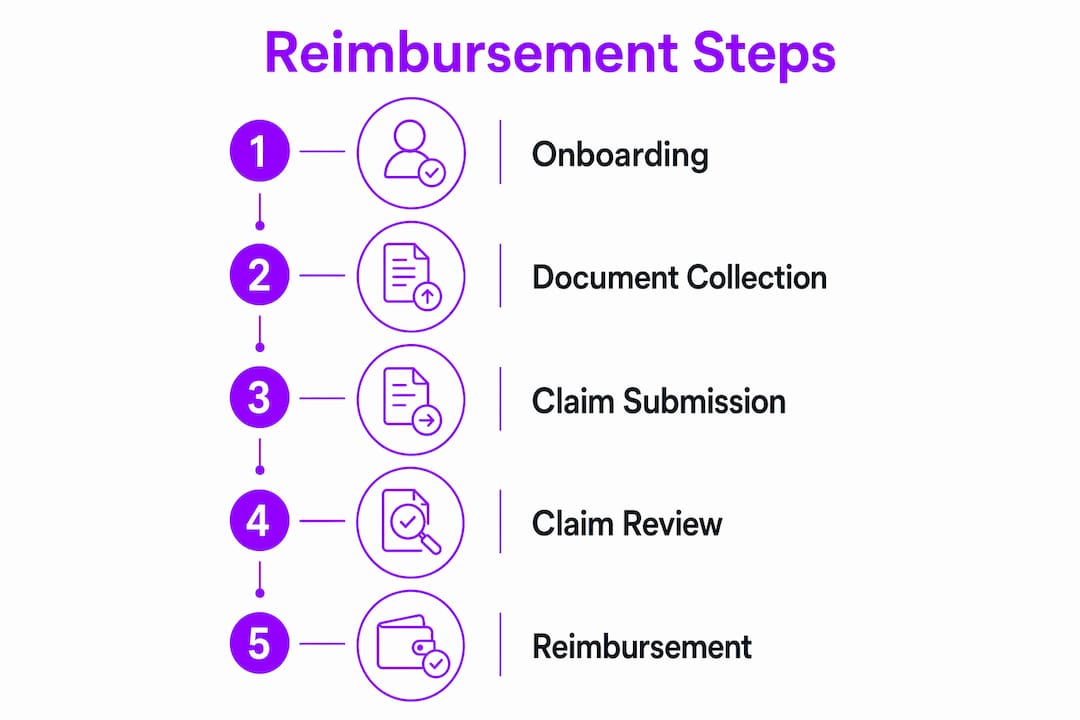
The reimbursement process follows a clear sequence. Employees need to understand each step before they need it, not during a hospital stay.
- Seek treatment. The employee visits any hospital or clinic, including facilities outside the insurer’s accredited network.
- Pay the bill. The employee settles the full amount at discharge. This is the upfront cash requirement that makes liquidity planning critical.
- Collect all documents. Original receipts, itemized bills, discharge summaries, prescriptions, and laboratory results must all be gathered before leaving the facility.
- Submit the claim. The employee files the claim with the insurer, typically within 30–90 days of discharge depending on the policy terms.
- Await settlement. Reimbursement claims settle in 30–45 days after complete document submission. That is weeks longer than the immediate discharge settlement of a cashless claim.
- Receive payment. The insurer deposits the approved amount, minus any non-covered charges, into the employee’s account.
The most critical step is document collection. Documentation errors cause most claim rejections, not coverage disputes. Missing original prescriptions, photocopied receipts instead of originals, or late submissions are the leading reasons claims get denied or reduced. Employees who understand this submit cleaner claims and get paid faster.
Pro Tip: Ask the hospital billing department for an itemized bill at discharge, not just a summary receipt. Itemized bills list every charge individually, which makes it easier to identify and remove non-medical items before submission.
HR managers should build a simple one-page claim checklist and distribute it during onboarding. Employees who have never filed a reimbursement claim often underestimate the documentation burden. A checklist removes that uncertainty before it becomes a problem.
What are the benefits of reimbursable insurance for Philippine SMEs?
The advantages of reimbursable insurance go beyond hospital choice. They affect how employees experience healthcare and how employers manage benefit costs.
- Unrestricted hospital access. Employees can visit any licensed hospital or specialist, including private facilities, teaching hospitals, and out-of-network specialists. This matters most in emergencies and for complex conditions requiring specific expertise.
- Specialist freedom. Cashless plans often require referrals and pre-authorization for specialists. Reimbursement plans remove that friction. An employee can book directly with a cardiologist or oncologist without navigating approval chains.
- Better outcomes for complex cases. When employees choose their own doctors and hospitals, they tend to seek care that matches their specific condition rather than defaulting to the nearest accredited facility.
- Employer cost control. Employers can manage benefit costs by defining reimbursement limits, setting eligible expense categories, and adjusting coverage tiers by employee level.
- Supplemental coverage flexibility. Reimbursement plans work well alongside PhilHealth and other base coverage, filling gaps that cashless plans may not address.
“Choosing reimbursement often reflects prioritizing healthcare quality and specialist choice over administrative ease. For employees with chronic conditions or specific healthcare needs, that tradeoff is worth it.”
Hmoplans, through its Purple Cow partnership, includes out-of-network reimbursement as part of its HMO offering for Philippine SMEs. That means employees get the cashless convenience of accredited hospitals like the Big 9 Hospitals and Healthway Clinics, plus the option to seek care outside the network and file for reimbursement. It is a mixed model that captures the benefits of reimbursable health plans without forcing employees to pay upfront for every visit.
What are common challenges when managing reimbursable health insurance?
Reimbursement plans carry real operational challenges. HR managers who ignore these risks end up with frustrated employees and high claim rejection rates.
- Upfront cash burden. Reimbursement shifts the cash flow burden to employees, who must cover full hospital bills before the insurer repays them. A major hospitalization can cost tens of thousands of pesos. Not every employee has that liquidity available.
- Higher deduction risk. Reimbursement claims carry higher risk of deductions due to non-medical charges like personal toiletries, companion meals, or administrative fees. These items appear on hospital bills but are not covered by most policies.
- Administrative load on employees. Reimbursement places the full administrative burden on employees, requiring disciplined document collection from admission through discharge. That is a significant ask during a stressful medical event.
- Delayed reimbursement stress. Waiting 30–45 days for repayment creates financial pressure, especially for employees living paycheck to paycheck.
- Appeal awareness gap. Most employees do not know they can challenge a denied claim. Employees can appeal denials caused by documentation deficiencies, not coverage exclusions. HR managers who communicate this right reduce unnecessary claim losses.
Pro Tip: Set up a small emergency medical fund or salary advance option for employees enrolled in reimbursement plans. It removes the liquidity barrier and prevents employees from delaying care because they cannot afford the upfront cost.
The financial impact on employees who must pay large medical bills before reimbursement arrives is a real retention risk. Employees who feel financially exposed by their health plan are more likely to look for employers with better benefits.
How can HR managers optimize reimbursable health plans?
Smooth reimbursement does not happen by accident. HR managers who build clear systems get better outcomes for their employees and fewer escalations.
- Train employees before they need it. Run a 30-minute onboarding session covering the claim process, required documents, and submission deadlines. Employees who understand the process before hospitalization make far fewer errors.
- Create a document checklist. List every required item: original receipts, itemized bills, discharge summary, attending physician’s certificate, and prescription copies. Distribute this as a printed card employees can keep in their wallet.
- Request itemized bills at every discharge. Obtaining itemized hospital bills at discharge minimizes surprise deductions and improves claim accuracy. Make this a standard instruction in your employee health guide.
- Set internal submission deadlines. Give employees an internal deadline that is two weeks earlier than the insurer’s cutoff. That buffer catches missing documents before the actual deadline passes.
- Partner with your insurer’s claims team. Build a direct contact with your insurer’s corporate accounts team. A single point of contact speeds up query resolution and reduces back-and-forth on incomplete submissions.
The table below summarizes the key actions HR managers should take at each stage of the reimbursement cycle.
| Stage | HR Action | Purpose |
|---|---|---|
| Onboarding | Distribute claim checklist and process guide | Prevents documentation errors before they happen |
| Hospitalization | Remind employee to collect itemized bill at discharge | Reduces deductions from non-medical charges |
| Post-discharge | Set internal submission deadline 2 weeks before insurer cutoff | Creates buffer to fix incomplete submissions |
| Claim review | Track submission status with insurer’s corporate team | Speeds up settlement and catches errors early |
| Denial response | Inform employee of appeal rights and resubmission steps | Recovers claims lost to fixable documentation issues |
For SMEs considering a mixed reimbursement and cashless approach, the best structure gives employees cashless access for routine and emergency care at accredited facilities, with reimbursement available for out-of-network situations. That design covers the most common scenarios without placing unnecessary cash flow pressure on employees.
Pro Tip: Ask your insurer for a digital claims portal or mobile submission option. Employees who can photograph and upload documents from their phone submit faster and with fewer missing items than those relying on physical mail.
Key Takeaways
Reimbursable health insurance gives Philippine SMEs greater flexibility and cost control, but it requires deliberate HR management to work well for employees.
| Point | Details |
|---|---|
| Reimbursement means pay first | Employees cover full medical costs upfront and recover them from the insurer within 30–45 days. |
| Hospital choice is the core advantage | Reimbursement plans allow access to any hospital, removing network restrictions that limit cashless plans. |
| Documentation drives outcomes | Most claim rejections come from missing or incorrect documents, not coverage exclusions. |
| HR systems reduce claim failures | Checklists, internal deadlines, and insurer contacts prevent the most common reimbursement errors. |
| Mixed plans balance both models | Combining cashless access with out-of-network reimbursement gives employees coverage flexibility without full upfront burden. |
Reimbursement plans in the real world: what I’ve seen work
Most articles on reimbursable health insurance treat it as a second-tier option. I disagree. For Philippine SMEs with employees spread across regions, reimbursement is often the more practical choice, not the compromise.
What I have seen in real business settings is that the failure point is almost never the plan itself. It is the gap between what HR communicates and what employees actually understand. A company can have excellent reimbursement coverage and still have employees who delay care because they are afraid of the upfront cost, or who lose claims because they threw away their original receipts.
The businesses that get this right treat the reimbursement process like a skill employees need to learn. They run short training sessions, keep the claim checklist visible, and designate one HR contact who knows the insurer’s process cold. That investment takes maybe two hours per year and it pays back in faster settlements and fewer escalations.
The other thing worth saying: reimbursement plans require employees who have some financial buffer. If your workforce is largely entry-level or living on tight margins, a pure reimbursement model creates real hardship. The better answer for most SMEs is a mixed plan, cashless for the majority of cases, with reimbursement available for out-of-network situations. That is exactly what Hmoplans offers through Purple Cow, and it is the structure I would recommend to any business owner who asks me.
— Eumir
Hmoplans and Purple Cow’s reimbursable health insurance for SMEs
Hmoplans, through its Purple Cow partnership, builds reimbursable health insurance into its standard HMO offering for Philippine SMEs. Members get cashless access to the Big 9 Hospitals and Healthway Clinics, plus out-of-network reimbursement for care sought outside the accredited network.
The plan covers pre-existing conditions, congenital conditions, and special procedures up to the Maximum Benefit Limit, with no complicated exclusion clauses. HR managers can review the full list of accredited providers to understand which facilities are covered under cashless access. For questions about claims, submissions, and member support, the member services page covers the full process. Hmoplans keeps the structure straightforward so HR teams spend less time managing exceptions and more time supporting their people.
FAQ
What is reimbursable health insurance?
Reimbursable health insurance is a plan where the insured pays medical expenses upfront and then submits a claim to recover those costs from the insurer. It differs from cashless insurance, where the insurer settles directly with the hospital at discharge.
How long does a reimbursement claim take to settle?
Reimbursement claims typically settle within 30–45 days after complete document submission. Cashless claims settle immediately at hospital discharge.
Why do reimbursement claims get rejected?
Documentation errors cause most rejections, including missing original receipts, incomplete prescriptions, or late submissions. Coverage exclusions are a less common reason than most employees assume.
Can employees appeal a denied reimbursement claim?
Yes. Employees can appeal denials caused by documentation deficiencies by resubmitting with the correct documents. HR managers should communicate this right clearly so employees do not abandon valid claims.
Is reimbursable insurance worth it for Philippine SMEs?
Reimbursable health insurance is worth it for SMEs whose employees need access to hospitals outside a standard network, particularly those with remote workers or employees in areas with limited accredited facilities. A mixed plan combining cashless and reimbursement options gives the best coverage balance for most Philippine SMEs.
