

Customize health benefits for SMEs: a practical guide
TL;DR:
- Generic health benefits often lead Philippine SMEs to lose their best talent due to inadequate coverage options. Customizing health plans based on workforce data ensures cost efficiency, higher utilization, and better employee satisfaction. Regular review and negotiation are essential for long-term value and workforce health management.
Generic health benefits are quietly costing Philippine SMEs their best people. When a 28-year-old software developer compares two job offers and one includes dental, annual physical exams, and full pre-existing condition coverage, the choice is obvious. Standard, off-the-shelf HMO plans often leave HR managers stuck with rigid structures that don’t reflect real workforce needs, wasted budget on coverage employees never use, and gaps that show up only during a medical emergency. This guide walks you through a concrete, step-by-step process to build a health benefit program that fits your team and your budget, complete with checklists, tables, and provider comparisons tailored for Philippine SMEs.
Table of Contents
- Why customization is crucial for SME employee health benefits
- Assessing your company’s needs and health coverage goals
- Choosing and customizing HMO plans: step-by-step for SMEs
- Overcoming common pitfalls and ensuring long-term value
- Expert perspective: Why customization works (and what most SMEs miss)
- Take your SME health benefits further with tailored solutions
- Frequently asked questions
Key Takeaways
| Point | Details |
|---|---|
| Supercharge retention with customization | Custom health benefits make it easier to attract and keep talent for SMEs in the Philippines. |
| Map your teams and needs first | Assess workforce demographics and priorities before considering HMO options. |
| Blend PhilHealth with HMO for best results | Combine mandatory government coverage with customizable HMO tiers for full protection. |
| Review and adjust plans yearly | Negotiate renewals and adapt coverage as costs and employee needs evolve. |
| Use brokers and compare every cycle | Expert help and competitive bidding yield better terms and broader choices for SMEs. |
Why customization is crucial for SME employee health benefits
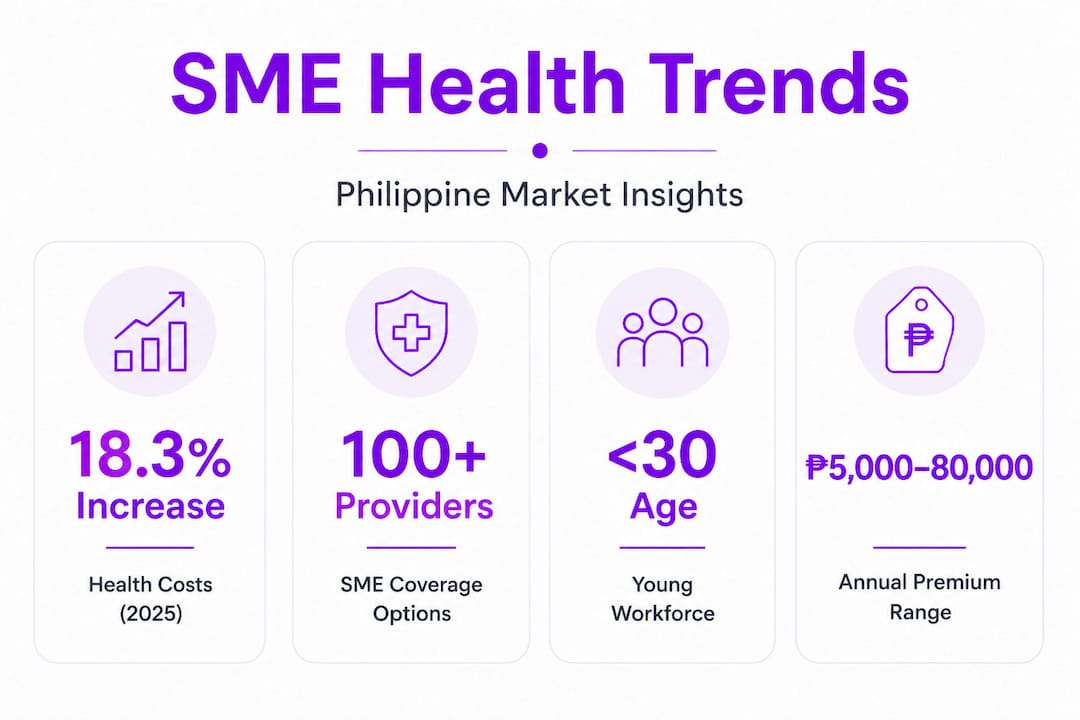
Philippine SMEs are navigating a healthcare market that is moving fast. Healthcare costs rose 18.3% in 2025, with the market projected to reach USD 17.8 billion by 2034 at a compound annual growth rate of 7.13%. For a company running on tight margins, that kind of cost escalation is not background noise. It directly affects your benefits budget.
At the same time, employee expectations have shifted. Workers today don’t just want health coverage. They want coverage that actually covers them. A 35-year-old with diabetes needs different protection than a 24-year-old fresh graduate with no health history. A field technician has different risk exposure than an office accountant. Standard group plans rarely account for that range of needs, and when employees discover the gaps, they leave.
Here is what makes customization non-negotiable for SMEs:
- Workforce diversity: Age gaps, varying health conditions, and different job risks mean one plan structure will inevitably under-serve a significant portion of your team.
- Budget efficiency: Paying for blanket coverage that employees don’t need or value is money lost. Targeted benefits deliver higher perceived value per peso spent.
- Talent competition: Larger companies have long used benefits as a recruiting edge. Customization lets SMEs compete without matching enterprise budgets.
- PhilHealth supplementation: The mandatory PhilHealth contribution handles basic inpatient case rates, but coverage ceilings are low. A custom HMO layer fills the gaps that PhilHealth cannot.
The good news is that optimizing healthcare costs is entirely achievable at the SME level. Understanding your workforce first is the foundation. With the problem clear, let’s examine what you’ll need to start customizing.
Assessing your company’s needs and health coverage goals
Before you request a single quote, you need data. HR teams that skip this step end up choosing plans based on price alone and then wondering why utilization is low or claims get denied. The assessment phase is where strategy is built.
According to best practices for group health policy customization, effective customization requires assessing group needs across age distribution, pre-existing conditions, and job roles, then researching providers via Insurance Commission listings, comparing quotes, and negotiating terms for custom features like cancer or dental coverage. Brokers are invaluable here for placement and claims advocacy.
Start by gathering this core workforce data:
- Age breakdown: What percentage of your employees are under 30, 30 to 45, and 45 and older? Older cohorts tend to have higher utilization and may need broader inpatient coverage.
- Known chronic conditions: Hypertension, diabetes, and thyroid issues are common in the Philippine workforce. These directly affect waiting period negotiations.
- Job role and risk level: Office-based, field-based, and hazardous environments each carry different coverage priorities.
- Current PhilHealth status: All employees should already be enrolled. Know exactly what your PhilHealth contributions cover so you can target your HMO supplementation precisely.
- Family dependency needs: Some employees may prioritize coverage that extends to dependents.
Once you have this picture, map it against the gaps PhilHealth leaves open. PhilHealth handles inpatient case rates and some day surgeries, but outpatient consultations, emergency room care, dental, and preventive exams are either minimal or absent. Your HMO layer should address those gaps directly through the right supplemental health benefits structure.
| Workforce profile | Top coverage priorities |
|---|---|
| Young workforce (avg age under 30) | Outpatient, dental, wellness, emergency care |
| Mixed age (30 to 50 range) | Inpatient, chronic disease management, cancer coverage |
| Field and hazardous roles | Accident insurance, emergency coverage, higher MBL |
| Senior-heavy team (50 and above) | High MBL, specialist access, cancer/cardiac coverage |
| Family-inclusive | Dependent coverage, maternity, pediatric benefits |
Pro Tip: Use an anonymous employee health survey before finalizing your needs assessment. You will often uncover undisclosed chronic conditions and specific benefit preferences that change your prioritization significantly.
A broker who specializes in Philippine group health insurance can help you build a shortlist of providers that match your profile. They also know which insurers are currently offering flexible terms, which is negotiating information you won’t get by calling providers directly. Once you understand your foundation, it’s time to explore provider and plan options.
Choosing and customizing HMO plans: step-by-step for SMEs
The Philippine HMO market has several group plan structures built specifically for companies with 5 to 199 employees. Selecting the right HMO for your workers primarily involves matching tiered group plans to your company size, workforce demographics, and budget, while layering on top of mandatory PhilHealth coverage.
Here is a structured process for making that selection:
- Define your must-have benefits. Based on your workforce assessment, list the non-negotiable coverage items. These typically include inpatient room and board, outpatient consultations, emergency care, and prescribed medicines up to a limit.
- Set your Maximum Benefit Limit (MBL) target. The MBL is the ceiling for what the plan pays per employee per year. Common SME ranges run from ₱50,000 to ₱500,000. Match this to your workforce health risk profile.
- Request quotes from at least three providers. Ask each provider for tiered options so you can compare across budget levels, not just at a single price point.
- Evaluate network reach. Check whether the provider’s accredited hospitals and clinics cover the locations where your employees actually live and work, not just Metro Manila.
- Negotiate add-ons. Dental HMO, annual physical exams, life insurance, and cancer coverage are typically offered as modular additions. Negotiate these as a package for better rates.
- Review pre-existing condition terms. This is where most SMEs lose value. Some providers cover pre-existing conditions from day one up to the MBL, which is a significant advantage for teams with known health histories.
MaxicarePlus serves companies with 10 to 99 employees and offers Platinum, Gold, Silver, and Bronze tiers with varying MBLs and optional cancer, dental, life, and wellness add-ons. It also covers pre-existing conditions up to the MBL. MediCard offers modular plans for 5 to 199 employees. Here is a simplified comparison to help frame your evaluation:

| Provider | Eligible company size | Tier structure | Pre-existing coverage | Notable add-ons |
|---|---|---|---|---|
| MaxicarePlus | 10 to 99 employees | Platinum, Gold, Silver, Bronze | Day 1 up to MBL | Cancer, dental, life, wellness |
| MediCard | 5 to 199 employees | Modular tiers | Year 2 onwards (standard) | Dental, maternity, life |
| Intellicare | 10 to 500 employees | Standard and enhanced | Year 1 with conditions | Annual PE, dental, critical illness |
| Medilink SME | 5 to 100 employees | Basic and enhanced | Year 2 standard | Outpatient, emergency, dental |
For SME health benefit options, the key differentiator across providers is rarely the base coverage. It’s the flexibility of add-ons and how pre-existing conditions are handled. Always ask for the specific exclusion list in writing before signing.
Pro Tip: When comparing quotes, ask each provider to include a summary of exclusions in plain language. The fine print on exclusions often reveals more about a plan’s real-world value than the coverage highlights sheet does.
Now that you know your options, ensure your plan holds up in the real world.
Overcoming common pitfalls and ensuring long-term value
Even well-designed SME health plans run into problems when HR teams don’t anticipate the operational and regulatory realities of the Philippine market. Here are the most common pitfalls and how to avoid them:
- Ignoring rural network gaps. Many HMO providers have strong coverage in Metro Manila, Cebu, and Davao, but thin accredited networks in provincial areas. If you have remote employees, confirm accredited hospital access in their specific localities before signing. When no accredited provider is available, most HMOs reimburse 80% for emergency care at non-accredited facilities, but that 20% still falls on the employee.
- Skipping employee communication. A benefit that employees don’t understand is a benefit they don’t use. A study of HMO utilization patterns shows low usage often stems from employees not knowing how to file claims or which clinics are covered, not from lack of need.
- Overlooking gender-specific needs. The Philippine insurance regulator is actively pushing for gender-specific coverage as costs climb, particularly given that the industry recorded ₱4.3 billion in HMO losses in 2023. Maternity, gynecological care, and prostate screening are increasingly relevant and often missing from basic plan structures.
- Underestimating annual cost creep. Renewal premiums typically increase each year based on your company’s claims history. Build a buffer into your annual benefits budget and negotiate renewal terms upfront, not at the last minute when you have less leverage.
- Forgetting about exit scenarios. Group plan coverage ends when an employee leaves, and conversion to an individual policy comes at a significantly higher premium. Communicate this clearly to employees so they understand their options and plan ahead.
A note on regulatory direction: The Insurance Commission is moving toward requirements for broader and gender-inclusive coverage, while rising claim costs are pushing premiums higher. SMEs that wait to reassess coverage annually will find themselves reacting to price increases instead of managing them proactively.
Ensuring long-term value means building a review cycle into your benefits calendar. Every 12 months, compare your current plan against market alternatives, assess your workforce demographics again for any shifts, and run a cost-versus-utilization analysis. Supporting your team’s health over time is an ongoing process, not a one-time decision.
Expert perspective: Why customization works (and what most SMEs miss)
Here is something most HR articles won’t tell you directly: SMEs often have more negotiating power than they realize. Providers want to grow their SME client base, and a company with 30 to 80 employees representing consistent annual premiums is a meaningful account for a regional broker or a tier-2 HMO provider. Most SME owners simply don’t know this, so they accept the first quote they receive as the only option.
The real missed opportunity we see is not in the plan selection itself. It’s in the annual reassessment. Companies spend significant time choosing a plan in Year 1 and then auto-renew for Years 2 through 5 without checking whether the plan still fits their workforce profile. The team you had when you signed the contract is not the same team you have three years later. Average employee age shifts. New hires come in with different health backgrounds. Job functions evolve. A plan that was well-matched in 2023 may be genuinely misaligned by 2026.
The second thing most SMEs miss is treating benefits purely as a cost line. When you optimize your healthcare spend with intent, health benefits become a recruiting asset that actively reduces your cost-per-hire. Candidates who decline offers from competitors because your benefits package is more comprehensive represent real, measurable savings that never appear on the HR budget spreadsheet but absolutely affect the bottom line.
Customization isn’t complicated. What it requires is intentionality, a willingness to negotiate, and a commitment to reviewing the plan as your company grows.
Take your SME health benefits further with tailored solutions
Building a health benefit program that genuinely serves your team doesn’t have to mean navigating a maze of complicated terms and opaque pricing. HMO Plans, partnered with Purple Cow and Etiqa, was built specifically for SMEs in the Philippines who want real coverage without the runaround.
Our plans include 100% coverage for pre-existing conditions, congenital conditions, and special procedures up to the MBL, with flexible add-ons including dental HMO, annual physical exams, and life and accident insurance. You get access to the Big 9 Hospitals and Healthway Clinics, plus out-of-network reimbursements and a digital platform for convenient claims and service access. Explore the full HMO plan features to see what your team could be covered for, or connect with our team through member services to start building a plan that fits your company today.
Frequently asked questions
How can SMEs combine PhilHealth and HMO coverage for maximum protection?
PhilHealth covers inpatient case rates and select day surgeries, such as pneumonia cases which now reach ₱29,500 post-2025 increases, while an HMO adds outpatient consultations, emergency room care, dental, and wellness benefits on top, creating layered coverage that addresses both routine and serious medical needs.
What are the typical costs for SME group health plans in the Philippines?
Annual HMO premiums for individual employees generally range from ₱5,000 to over ₱80,000 per year, with group rates typically lower than individual rates, and MBLs commonly ranging from ₱50,000 to ₱500,000 depending on the plan tier.
Are pre-existing conditions covered by custom HMO plans?
Coverage for pre-existing conditions varies by provider. For example, Maxicare covers them from day one up to the MBL, while other providers typically apply a waiting period before full coverage kicks in, often in Year 2.
What happens to employee health coverage when someone leaves the company?
Group plan coverage ends when employment ends, but conversion to an individual plan is available at a higher premium. HR teams should communicate this to employees as part of their onboarding and offboarding processes.
