

Accredited Hospital Networks: What HR Teams Must Know
An accredited hospital network is your HMO insurer’s official roster of partner hospitals and clinics authorized to provide cashless, in-network care to covered members. When your employee visits one of these facilities, the hospital bills the insurer directly, so your team member walks out without paying upfront, subject to plan rules.
Here is what that means in practice for your SME:
- Cashless access: Members present their HMO card or digital pass; the facility coordinates payment with the insurer directly.
- No upfront payment for covered services: Inpatient admissions, emergency care, outpatient consults, and diagnostics at accredited facilities are settled between the hospital and insurer, up to the Maximum Benefit Limit (MBL).
- Verification is fast: Members can confirm a facility’s in-network status through the insurer’s member portal or mobile app, a 24/7 customer service hotline, or by asking the clinic to swipe the member card on arrival.
- Out-of-network care is different: Treatment at a non-accredited facility typically requires the member to pay out of pocket first and then file for reimbursement, which may be partial or denied depending on the plan.
Key Takeaways
An accredited hospital network is the insurer’s roster of partner facilities where members receive cashless care, and choosing a plan with strong network depth, written pre-auth SLAs, and digital verification tools is the most direct way HR can protect employees from surprise costs.
| Point | Details |
|---|---|
| Definition of accredited network | The insurer’s contracted roster of hospitals and clinics authorized for cashless, in-network HMO benefits. |
| Cashless vs. reimbursement | Accredited facilities bill the insurer directly; non-accredited care requires upfront payment and a reimbursement claim. |
| Verify before every planned visit | Use the member app, hotline, and hospital billing office to confirm network status and pre-auth requirements. |
| HR must negotiate SLA in writing | Insist on a written pre-authorization turnaround commitment in the group contract, not a verbal assurance. |
| Hmoplans for SMEs | Offers cashless access to premier hospitals, 24/7 coverage, and MBL coverage for pre-existing conditions. |
Table of Contents
- What does “accredited” actually mean for your employees?
- How an employee uses an accredited hospital, step by step
- What HR should check before buying a group HMO plan
- Common pitfalls that lead to surprise costs
- Quick verification checklist and scripts
- Why network quality is the real measure of an HMO plan
- Hmoplans: built for SMEs that need real network access
- Sources
What does “accredited” actually mean for your employees?
The term “accredited” in the HMO context describes a contractual partnership between the insurer and a hospital or clinic. The insurer negotiates rates for covered services, and the facility agrees to accept those rates and handle billing directly. This is distinct from government facility accreditation: PhilHealth’s facility accreditation process classifies hospitals by level (Level 1, 2, or 3) and facility type (ambulatory surgical clinics, dialysis centers, maternity clinics), but insurer in-network accreditation is a separate, private contractual arrangement.
Cashless vs. reimbursement: At an accredited facility, the member pays nothing for covered services beyond any non-covered items on the bill. At a non-accredited facility, the member pays the full bill and submits receipts for partial reimbursement, which often takes weeks and may not cover the full amount.
Common covered services at accredited facilities include inpatient room and board, emergency stabilization, physician consults, laboratory tests, and imaging. Frequent exclusions are cosmetic procedures, elective dental work (unless a dental rider is active), and experimental treatments. Review your plan’s inpatient benefit categories to know exactly what applies.
Pre-authorization is the insurer’s advance approval for a planned admission or procedure. Without it, a cashless claim can be denied even at an accredited facility.
Maximum Benefit Limit (MBL) is the annual cap on what the insurer pays per member. Once reached, the member covers remaining costs personally.
| Verification method | What it confirms | Action to take |
|---|---|---|
| Member portal or mobile app | Real-time in-network status of a specific facility | Search by hospital name before booking |
| 24/7 customer service hotline | Network status plus pre-auth requirements | Call and note the CSR name and reference number |
| Hospital billing office | Whether the facility accepts your specific card tier | Ask billing staff to verify your plan code |
| Card swipe at clinic | Eligibility and coverage at point of care | Present card on arrival; request printed confirmation |
Pro Tip: Always verify using at least two methods for planned admissions. A portal listing can lag behind real-time contract changes, so a hotline call adds a second layer of confirmation.
How an employee uses an accredited hospital, step by step
Follow these steps to get cashless care and avoid surprise bills.
- Verify accreditation before you go. For planned care, check the insurer app or portal, then call the hotline to confirm your specific plan tier covers that facility. For emergencies, go to the nearest accredited ER and notify your insurer as soon as you are stable. Detailed emergency HMO workflows explain when and how to notify your insurer.
- Present your HMO card or digital pass on arrival. Confirm with the admissions desk that your service and room type are covered under your plan tier. Bring a valid government ID alongside your member card.
- Request pre-authorization for admissions and scheduled procedures. Confirm in writing what the authorization covers: room category, specific procedures, and diagnostics. Keep the Letter of Authorization (LOA) with you throughout your stay. The complete hospital admission guide walks through this process in full detail.
- Review your bill at discharge. The hospital will separate covered items (settled cashless) from non-covered items (your personal responsibility). Sign only after you understand each line. Ask billing staff to clarify any charge you do not recognize.
- Keep all paperwork after discharge. Store your LOA, authorization reference numbers, and official receipts. If you received care out-of-network and your plan allows reimbursement, file within the deadline stated in your policy documents.
Quick admission checklist:
- HMO card or digital pass plus valid ID
- Pre-authorization reference number (for planned admissions)
- Copy of the LOA
- List of covered procedures confirmed by the insurer
- Contact number for the insurer’s 24/7 hotline
Employees who skip pre-authorization for non-emergency admissions face the most common claim denials. Treating a planned procedure as an emergency to bypass pre-auth is a frequent and costly mistake.
What HR should check before buying a group HMO plan
Network quality is the single factor that most directly affects whether your employees actually use their benefits. A plan with a low premium but a thin network often costs more in out-of-pocket expenses and lost productivity than a slightly pricier plan with broad coverage.
Evaluation checklist for HR:
- Network breadth: Total number of hospitals and clinics, with regional distribution across your employees’ home cities and provinces.
- Key tertiary hospitals: Confirm that major hospitals your employees trust are included. Check the list of premier HMO hospitals as a benchmark for what a strong SME network looks like.
- Specialty coverage: OB-Gyn, pediatrics, orthopedics, and oncology should be available at accredited facilities, not just general medicine.
- 24/7 emergency cashless policy: Confirm that ER cashless access applies around the clock, not just during business hours.
- Pre-authorization SLA: Ask for the insurer’s committed turnaround time for LOA issuance. Two hours or less is a reasonable standard for urgent admissions.
- Out-of-network reimbursement policy: Understand the reimbursement percentage, filing deadline, and which exclusions apply.
- Balance billing policy: Confirm whether the insurer’s negotiated rates fully cover standard room charges or whether members routinely face top-up bills.
- Digital verification tools: Test the member portal and app yourself before signing. A directory that is difficult to search or frequently outdated is a red flag.
Pro Tip: Ask the insurer to include pre-authorization SLA commitments in the service-level agreement (SLA) section of your group contract. Verbal assurances are not enforceable; written SLAs are. Broad accredited networks also directly support SME employee retention, a business outcome worth weighing alongside premium cost.
Red flags to watch for: limited provincial coverage, vague or undocumented pre-auth rules, slow claim response times, and large lists of mandatory exclusions or required top-ups. A broader accredited network lowers out-of-pocket risk and supports retention for SMEs.
Common pitfalls that lead to surprise costs
Balance billing happens when a hospital charges above the insurer’s negotiated rate and passes the difference to the member. Prevent it by confirming accepted room types and the insurer’s room rate cap before admission, not at discharge.

Pre-authorization denials most often result from missing documentation, a procedure that falls under a waiting period, or a service the plan classifies as excluded. If a denial arrives, request the insurer’s written reason immediately and ask whether an appeal or interim authorization is available.
Plan tier mismatch catches employees off guard. Not every accredited hospital accepts every card tier. A member with a basic plan tier may find that a specific hospital only accepts premium tier cards. Always verify the specific tier, not just the facility name.
Waiting periods and pre-existing condition rules vary by plan. Some procedures tied to a pre-existing condition may be subject to a waiting period even if the insurer claims broad coverage. Confirm whether the specific diagnosis or procedure falls under any rider requirement before scheduling.
Practical avoidance steps:
- Run pre-checks for every planned admission, not just major surgeries.
- Train HR staff on the admission and pre-auth process so they can guide employees quickly.
- Use accredited network providers for all elective care.
- Keep a folder (digital or physical) with LOAs and authorization reference numbers for each employee claim.
Quick verification checklist and scripts
Before calling or emailing, have these details ready:
- Company plan name and card tier
- Member ID number
- Full name of the facility and specific department
- Planned date of service
- Procedure description or code
- Pre-auth requirement and expected SLA
Phone script for the insurer hotline:
Phone script for the hospital billing office:
Email template subject line: In-Network Verification Request — [Member ID] — [Facility Name] — [Date of Service]
In the body, include: member ID, plan tier, facility name and department, planned service date, procedure description, and a direct question asking for written confirmation of accreditation status and pre-auth requirements.
Pro Tip: Ask the hospital billing officer for an internal authorization or reference number after verbal confirmation. Note the name of the representative and the time of the call. This record is your protection if a billing dispute arises later.
Why network quality is the real measure of an HMO plan
HR teams often evaluate group HMO plans primarily on premium cost. That is the wrong starting point. A plan’s accredited network determines whether your employees can actually use their benefits without financial stress, and whether your company avoids the productivity drain of contested claims and reimbursement delays.
The most overlooked factor is geographic depth. A network that covers major Metro Manila hospitals but leaves provincial employees with limited options creates a two-tier benefit that undermines the purpose of group coverage. Before signing any group contract, map your employee locations against the insurer’s network directory, not just the headline hospital count.
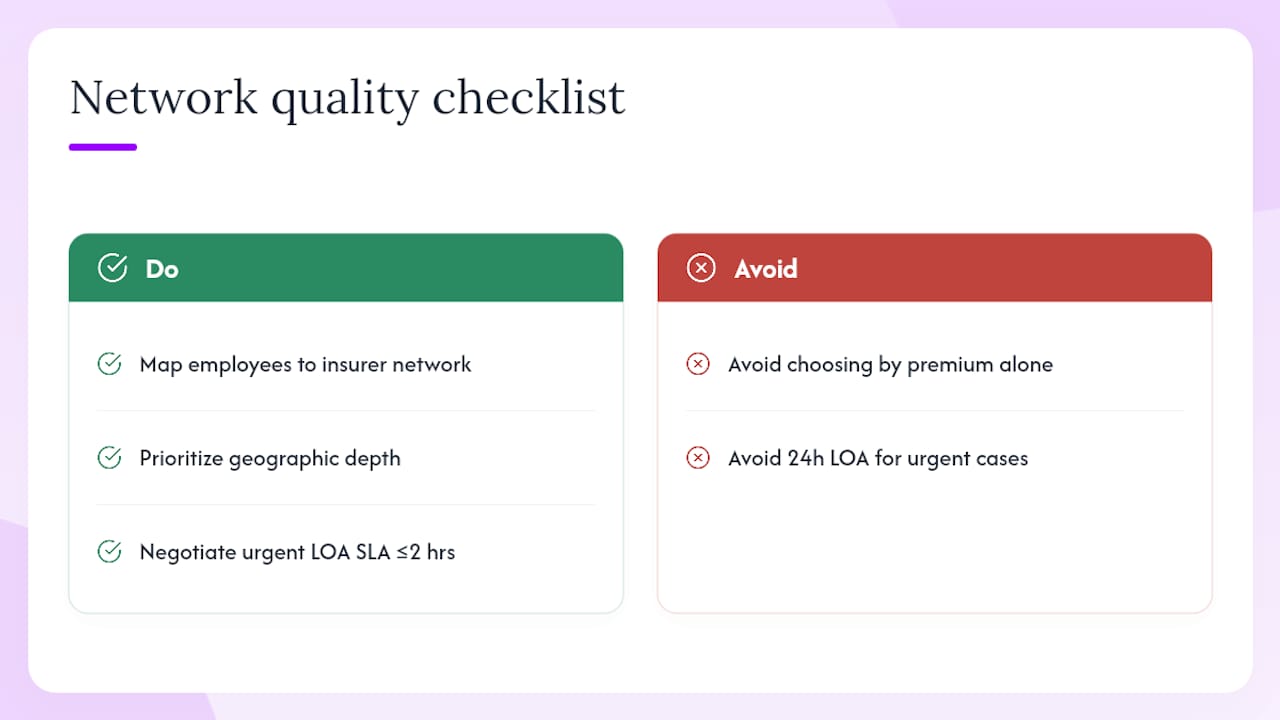
Pre-authorization SLA is equally underweighted. An insurer that takes 24 hours to issue an LOA for an urgent admission creates real clinical risk. Negotiating a written SLA of two hours or less for urgent cases is one of the highest-value actions HR can take during procurement.
Hmoplans: built for SMEs that need real network access
For HR teams coming from this article, the practical fit is direct: Hmoplans offers the network breadth, transparent pre-auth support, and digital verification tools this guide recommends you prioritize. Optional add-ons for dental, annual physical exams, and life and accident insurance let you build a plan that matches your team’s actual needs without paying for coverage they will not use. Talk to the Hmoplans team and get a plan tailored for your SME today.
Sources
Use these resources to verify accreditation status and deepen your understanding of how HMO networks work in the Philippines:
- HMO Accredited Clinics Philippines 2026: Maxicare, PhilCare, Medicard
- Accreditation Process: Health Facilities | PhilHealth
This article is general information, not a substitute for advice from a qualified financial advisor. Consult a qualified financial professional about your own circumstances before acting on anything here.
