

HMO portability explained: What SME owners need to know
TL;DR:
- HMO plans in the Philippines are employer-specific and do not automatically transfer to employees after separation. Employees can maintain PhilHealth benefits and have limited options for conversion or continuation of their private HMO coverage through specific procedures. SMEs should proactively design benefits and communicate clearly to ensure smoother health coverage transitions post-employment.
Many SME owners and HR managers assume that when an employee leaves the company, their HMO coverage simply follows them to their next job. It doesn’t. HMO portability in the Philippines refers to limited post-separation options, not a seamless transfer of benefits between employers. This distinction matters enormously for how you design your benefits package, how you communicate coverage to your team, and how you protect employees during career transitions. This article breaks down exactly what portability means, what happens to coverage after someone leaves, and what your SME can do to build a more flexible and employee-friendly health plan.
Table of Contents
- What HMO portability really means in the Philippines
- What happens to HMO coverage after job separation?
- Conversion privilege and continuation: How they work
- Legal and policy realities: No guaranteed HMO portability
- Best practices: Designing SME HMO plans with flexibility in mind
- The real story: Why “portability” is a misnomer for SME HMO plans
- Next steps: Finding the best HMO solutions for your SME
- Frequently asked questions
Key Takeaways
| Point | Details |
|---|---|
| HMO portability is limited | Private HMO plans rarely transfer between employers and true portability is uncommon in the Philippines. |
| Conversion privilege is key | Employees leaving a company can often convert their plan if they act quickly but benefits and premiums may change. |
| Legal coverage is contract-based | No law requires post-job HMO coverage, so it depends on the employer’s contract and policy. |
| PhilHealth is always portable | State-run PhilHealth is portable and follows you across employers for lifelong health protection. |
| SMEs can add flexibility | Proactive SMEs can negotiate for portability-like features to attract and keep top talent. |
What HMO portability really means in the Philippines
Before we can fix a misunderstanding, we need to name it clearly. An HMO, or Health Maintenance Organization, is a prepaid healthcare plan that gives members access to a network of hospitals, clinics, and doctors. For SMEs, most HMO plans are structured as corporate group plans. The employer pays the premium, the HMO provides the benefit, and the employee gets access while they remain employed.
Here’s the problem with assuming portability: corporate HMO plans are employer-specific, meaning the plan belongs to the company, not the individual. When an employee leaves, the plan stays with the employer. There is no mechanism that automatically transfers the same HMO plan to the employee’s next job.
This is fundamentally different from PhilHealth, the national health insurance program. PhilHealth is portable across employers through lifelong membership, meaning contributions follow the individual regardless of how many times they change jobs. Private HMO supplements it but does not work the same way.
Understanding the difference between PhilHealth and HMO coverage helps you set the right expectations when explaining benefits to employees.
What is and isn’t portable for employees in the Philippines:
- Portable: PhilHealth membership and contribution history
- Portable: SSS and Pag-IBIG contributions
- Not portable: Private HMO corporate group plans
- Not portable: Accredited network benefits and existing claims history
- Limited option: Conversion to an individual HMO plan upon separation
- Rare option: Continuation of the corporate plan if both the HMO and employer agree
“True portability, where an employee carries the exact same HMO plan to a new employer, is uncommon and generally not available in the Philippine private HMO market.”
This is the baseline truth that every SME owner and HR manager needs to internalize before designing or communicating a benefits package.
What happens to HMO coverage after job separation?
Once you understand what portability isn’t, the next question is practical: what actually happens to coverage when someone leaves your company?

The short answer is that coverage typically ends on the last day of employment or at the end of the billing cycle, depending on your HMO contract. But there are a few paths available after that point, and knowing them well means you can guide your employees properly during offboarding. Understanding how these options connect to overall HMO wellness benefits is key to building a complete picture.
Here’s the typical sequence after job separation:
- Coverage termination. The employee is removed from the corporate group plan, usually at the end of the employment date or the next billing cycle.
- Notification period. The employee should receive information from HR or the HMO about available options. In practice, this step is often skipped or done poorly.
- Conversion application window. The employee has a limited window, often 30 days, to apply for an individual or family HMO plan under a conversion privilege. This new plan may credit prior coverage periods and typically has different premiums and benefits.
- Continuation request (rare). In some cases, former employees can stay on the corporate plan by paying the premium themselves, but only if the HMO provider and employer agree. This is not standard practice.
- Coverage gap. If the employee does not act quickly, they may face a period with no private health coverage. This is the most common outcome.
Pro Tip: Remind separating employees about the conversion window during their exit interview. Most people don’t know it exists, and missing it can leave them uninsured for months. A simple checklist in your offboarding process can prevent this entirely.
HR managers who want to maximize HMO benefits for their workforce should treat offboarding communication as an extension of the benefits program, not a formality.
Conversion privilege and continuation: How they work
Let’s go deeper into the two main options available after separation: conversion and continuation. These are the actual mechanics behind what people loosely call “portability.”
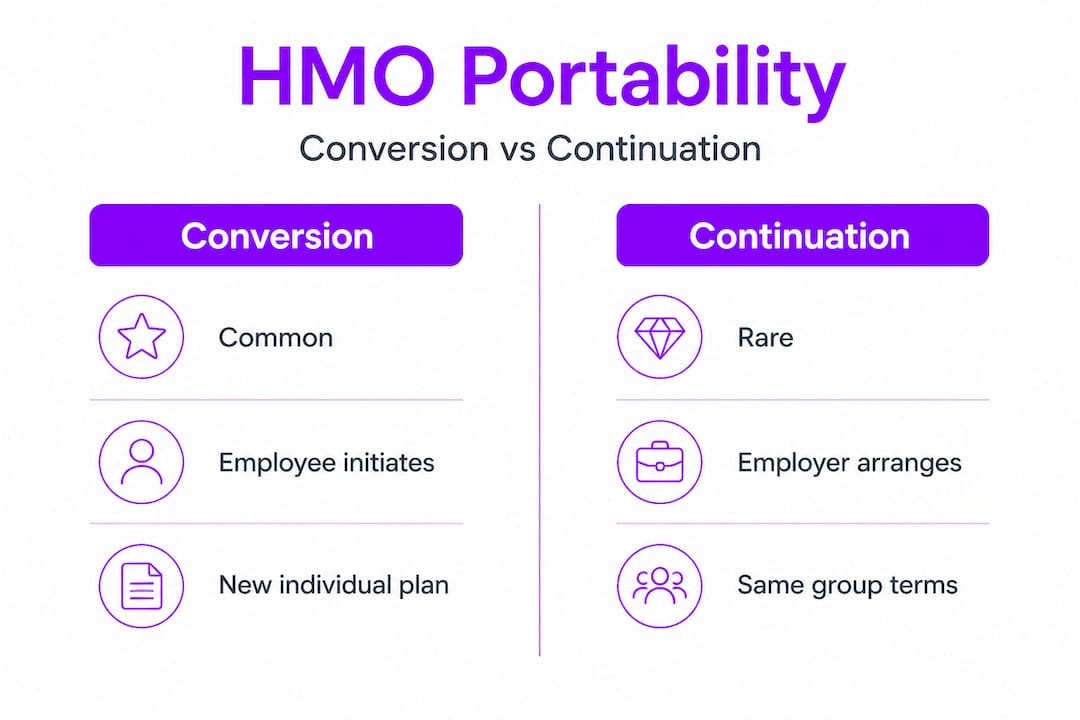
Conversion privilege is the more common and more realistic option. It allows a separated employee to convert their group HMO membership into an individual or family plan. The key conditions:
- The application must be submitted within the HMO’s conversion window, which varies by provider but is often 30 days after separation
- The converted plan will likely have higher premiums since the employer subsidy is removed
- Benefits may change, often with different benefit limits or different network access
- Some HMOs credit the employee’s prior coverage period toward waiting periods on the new plan
- Pre-existing conditions that were already covered may or may not carry over, depending on the specific HMO’s terms
Continuation is the rare alternative. Under this arrangement, a former employee remains enrolled in the corporate group plan but pays the premiums out of pocket. This is uncommon because:
- Most HMOs structure corporate plans exclusively for active employees
- Employers are not obligated to allow it
- Premiums are typically higher when the group subsidy is removed
The table below gives a side-by-side view of both options:
| Feature | Conversion privilege | Continuation |
|---|---|---|
| Availability | Common | Rare |
| Who initiates | Employee | Employee or employer |
| Premium responsibility | Employee pays full individual rate | Employee or employer pays |
| Benefits | May change from group plan | Same as group plan while active |
| Time limit to apply | Usually 30 days post-separation | By agreement only |
| Network access | May differ | Same as current group plan |
| Pre-existing coverage | Varies by HMO | Maintained while enrolled |
What’s called “portability” in casual conversation often just means conversion or new enrollment. There is no standardized portability mechanism across private HMO providers in the Philippines, which is why so many employees are caught off guard when they leave a job.
For SMEs thinking about how to customize HMO benefits to retain talent, building conversion support into your offboarding process is a low-cost but high-impact differentiator.
Legal and policy realities: No guaranteed HMO portability
This is where many SME owners get a rude awakening. There is no Philippine law that requires employers to extend HMO coverage after employment ends.
No universal law mandates post-termination HMO coverage. What determines post-separation coverage is a combination of the employer-HMO contract, company policy, a collective bargaining agreement if one exists, or established company practice. If your company has consistently extended coverage to separated employees in the past, stopping that practice without replacement benefits could trigger a labor dispute under the principle of non-diminution of benefits.
“What employees actually receive after separation depends almost entirely on what the employer and HMO agreed to in their contract. The law is silent on mandating continuation.”
Another important legal nuance: if your company decides to switch HMO providers, that is generally allowed under management prerogative. But changing HMO providers only passes legal muster if the new coverage is not substantially diminished. That means network adequacy must be maintained, and the Maximum Benefit Limit cannot drop significantly. If the new plan is meaningfully worse, employees may have grounds for a complaint under Article 100 of the Labor Code, which prohibits the reduction of established benefits.
The table below summarizes how coverage after separation is determined:
| Determining factor | What it means for employees |
|---|---|
| Employer-HMO contract | Sets explicit terms for post-separation options |
| Company policy | Internal rules may extend or limit coverage |
| Collective bargaining agreement | Union negotiated terms may require conversion support |
| Established practice | Consistent past behavior may create implied obligation |
| No policy or contract clause | Coverage ends at separation with no guaranteed options |
Pro Tip: Before an employee’s last day, review your HMO contract together with HR and legal counsel to confirm exactly what the plan says about separation. Don’t assume. The contract language governs, not verbal commitments.
SMEs that want to stay competitive should review how they choose SME HMO plans with an eye on conversion clauses and understand the advantages of comprehensive HMO coverage as a retention tool even beyond employment.
Best practices: Designing SME HMO plans with flexibility in mind
Now for the actionable part. Even if true portability doesn’t exist, SMEs can design their health benefits to be far more flexible, transparent, and employee-friendly than the industry default.
Actionable steps for SME owners and HR managers:
- Negotiate conversion clauses explicitly. When renewing or selecting an HMO provider, ask directly whether the plan includes conversion privilege and what the terms are. Not all HMO contracts include this by default, and SMEs can negotiate portability-like features to make their plans more attractive.
- Create a benefits transition checklist. Build a simple document that every departing employee receives. Include conversion deadlines, who to contact at the HMO, and what documents they need.
- Educate employees proactively. Don’t wait for offboarding to explain conversion options. Include a section in your employee handbook about what happens to HMO coverage when employment ends.
- Coordinate PhilHealth coverage explicitly. Remind separated employees that PhilHealth remains active even after they leave. While it doesn’t replace private HMO, it provides a meaningful safety net while they arrange new coverage.
- Facilitate the conversion process. Offer to help employees initiate their conversion application before their last day if possible. Some HMOs allow this, and it removes a stressful task from the departing employee’s plate.
- Review your contract annually. Benefits needs and provider offerings change. An annual review of your HMO contract ensures you’re not locked into terms that no longer serve your team.
Pro Tip: Positioning your SME as one that supports employees through coverage transitions, not just while they’re employed, is a genuine differentiator in hiring. Candidates increasingly ask about offboarding benefits as part of total compensation discussions.
Thinking carefully about how to customize health insurance for SMEs means building flexibility into the plan design from the beginning, not scrambling to explain gaps when someone resigns.
The real story: Why “portability” is a misnomer for SME HMO plans
Here’s the perspective that rarely gets said directly: the word “portability” is doing a lot of work it was never designed to do.
When employees hear “your HMO is portable,” they often picture carrying their exact plan, network, and coverage limits from one job to the next without interruption. That image is fiction for private HMO plans in the Philippines. Corporate HMO plans are employer-specific, and no matter how good your broker is or how well-intentioned your HR team is, that structural reality doesn’t change.
What actually exists is a patchwork of conversion options, continuation exceptions, and contract-specific clauses. That’s not portability. That’s flexibility, and it’s a meaningfully different concept. Flexibility requires deliberate design, clear communication, and proactive management. Portability, by contrast, implies something automatic.
The mistake SMEs make is treating HMO portability as a policy question when it’s actually a communication and contract design question. If you want your employees to have health coverage continuity, you have to build that into the HMO contract you sign, the policies you document, and the offboarding experience you create.
From our experience working with SMEs across industries, the companies that handle health coverage transitions well aren’t necessarily those with the most expensive plans. They’re the ones that treat the conversion window as a responsibility, not an afterthought. They brief employees early, maintain relationships with their HMO account managers, and ensure that departing employees have a clear next step rather than a confusing dead end.
The mindset shift worth making is this: stop asking “how do we make HMO portable?” and start asking “how do we make coverage transitions as smooth as possible?” That second question has real answers. You can learn more about those answers by exploring ways to maximize healthcare coverage for employees as part of a long-term benefits strategy.
Flexibility, communication, and smart contract negotiation. That’s the real path forward for SMEs.
Next steps: Finding the best HMO solutions for your SME
Now that you have a clear picture of how HMO portability really works, the best move is to review what your current plan actually says and whether it’s designed to serve your employees well, both during and after employment.
At HMO Plans, we work with SMEs across the Philippines to design health coverage that’s straightforward, comprehensive, and genuinely flexible. Our plans through Purple Cow and Etiqa include 100% coverage for pre-existing conditions, customizable add-ons, and clear terms that you and your employees can actually understand. Whether you’re building a plan from scratch or rethinking your existing coverage, explore our SME HMO features to see what’s possible. You can also connect with our team through HMO member services for a consultation tailored to your company’s size, industry, and budget.
Frequently asked questions
Can an employee carry their HMO plan to a new employer?
No, private HMO plans are typically employer-specific and do not transfer with the employee to a new company. The new employer must enroll the employee in their own group plan.
What are the deadlines for converting HMO coverage after leaving a job?
You usually must apply for conversion promptly after separation, often within 30 days, but deadlines vary by provider so always confirm with your specific HMO.
Is there any portable health insurance for employees in the Philippines?
Yes, PhilHealth is portable across all employers through lifelong membership, but private HMO coverage does not carry the same portability guarantee.
Can a company be forced to extend HMO coverage after employment ends?
No, no universal law mandates post-termination HMO coverage. Continuation depends on the employer-HMO contract, company policy, or collective bargaining agreement.
Can employees stay on their old HMO by paying premiums themselves?
This is rare and only possible if the HMO and employer allow it. It is typically a temporary arrangement and not a standard feature of corporate group plans.
